Québec Becomes the First Region to Support Global Biodiversity Fund with Historic Investment in Nature
Québec, CanadaFinancing the fight against biodiversity loss is a global challenge, and Québec is taking a leading role. Reversing the decline of species and ecosystems is estimated to require an investment of US $200 billion per year by 2030 (Target 19). While national governments are central to these efforts, subnational governments manage vast forests, freshwater systems, coasts, and protected areas – and until now, they have had little direct access to international funding.
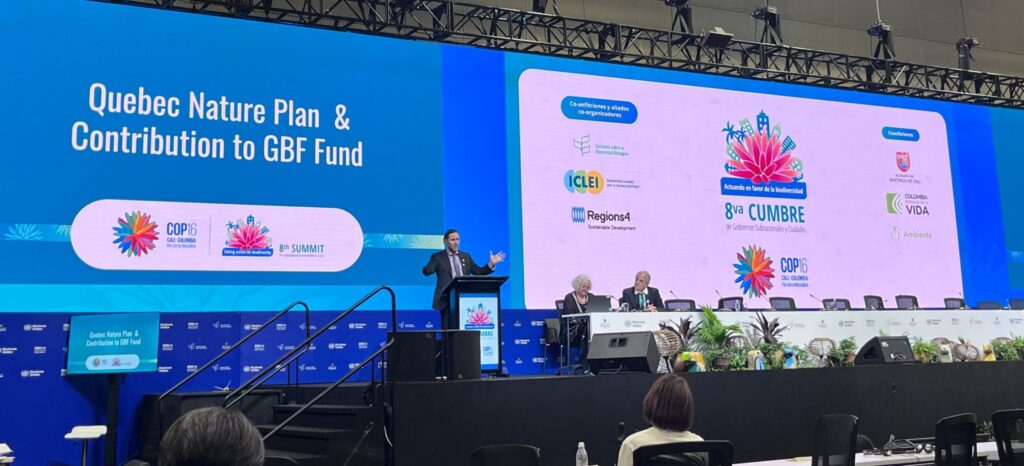
At COP16 in October 2024, the Government of Québec became the first subnational government to contribute directly to the Global Biodiversity Framework Fund (GBFF), committing to support biodiversity action in developing countries. This historic contribution brings local stewardship directly into the global conservation effort and signals a structural shift: biodiversity finance is no longer the sole responsibility of national governments. Subnational actors can now play a direct role, combining local action with global solidarity.
A finance gap that calls for new approaches
Even with global commitments in place, biodiversity finance remains insufficient to meet the ambitions of the Kunming–Montreal Global Biodiversity Framework (KMGBF). Target 19 specifically calls for scaling up financial resources for biodiversity, highlighting the need to mobilize new sources of funding. In this context, contributions from subnational governments can help expand the range of actors supporting global biodiversity finance.
Biodiversity is underfunded worldwide. Public budgets face competing priorities while ecosystems continue to degrade. Bridging this gap requires broadening participation and strengthening trust in multilateral funds.
Québec’s contribution reflects the understanding that biodiversity loss knows no borders. Ecosystem services, including climate regulation, carbon storage, water filtration, and soil fertility, support global economic stability and human well-being.
By contributing to the GBFF, Québec emphasizes that international biodiversity finance is a shared risk management that benefits all jurisdictions, including those acting domestically.
Linking internal ambition with global responsibility
Québec’s international contribution is built on strong domestic action. Through its 2030 Nature Plan, supported by CAD $922 million, Québec is protecting and restoring ecosystems across its territory.
Quebec’s financial support to the GBFF complements this domestic investment. It ensures coherence between local implementation and global commitments.
Québec’s approach shows that regions can act at multiple levels:
• Deliver ambitious action at home
• Participate directly in global funding mechanisms
• Support international environmental solidarity
By operating at both domestic and international levels, Québec shows that leadership in biodiversity is not limited by jurisdiction.
From contribution to influence
By contributing to the GBFF, Québec secured a seat on the GBFF Advisory Committee, making it the only subnational contributor represented in this multi-stakeholder governance body.
This position allows Québec to:
• Shape the fund’s strategic direction
• Promote transparency, accountability, and inclusivity
• Engage directly with global biodiversity finance discussions
• Access program workplans and evaluation processes
Through this role, Québec strengthens the influence of subnational governments within global biodiversity governance. Since the fund’s launch in August 2023, it has received US $386 million in pledges from 12 contributors and allocated over US $200 million to 41 countries. The fund prioritizes Indigenous Peoples, local communities, Small Island Developing States (SIDS), and Least Developed Countries (LDCs), ensuring resources reach those most affected.
Accountability and monitoring
Monitoring is central to Québec’s biodiversity strategy. The 2024–2028 Action Plan implementing the 2030 Nature Plan identifies preliminary indicators aligned with GBF targets.
As of November 2025, Québec was developing a broader set of indicators in consultation with ministries, academia, and Indigenous nations and organizations.
This ensures that Québec’s international contribution is embedded in a results-oriented domestic strategy. Transparency and measurable outcomes, both at home and abroad, remain crucial for public trust in biodiversity finance.
Why this matters for COP17
As COP17 approaches, delivering sufficient, predictable, and transparent funding is critical. Québec’s experience shows that subnational innovation can complement national and international efforts.
By combining strong domestic action with global financial participation, Québec provides a model for other regions and states that can replicate. Scaled up, such contributions could significantly increase global biodiversity funding.
More broadly, Québec highlights an important lesson: achieving the Global Biodiversity Framework (GBF) requires coordinated action at all levels of government . Subnational actors not only manage ecosystems and implement policies but also engage stakeholders and, as Québec shows, can now contribute directly to global conservation finance. Strengthening this multilevel approach is essential to close the gap between international ambition and tangible results on the ground.
GBF target addressed: 19.
Focus area: Biodiversity finance; Multilateral cooperation; Subnational leadership; Global environmental governance.
Read more:
- Québec’s 2030 Nature Plan
- Joint statement on donors’ pledge of $163 million and confirmation of support to the Global Biodiversity Framework Fund
#RegionsVoice brings the voice of regional governments to major events and negotiation processes on sustainable development within the UN. The campaign brings visibility and wider recognition of the role of regional governments in sustainable development, by elevating both individual and collective messages and engaging with a wider audience during the UN Decade of Action.
More actions in this region
- 5 million CAD invested annually

Direct Health Assistance
Québec, Canada The government of Quebec provides direct health assistance to its population- Climate Monitoring

Ecological Connectivity and Climate Transition in Quebec
Québec, Quebec Ecological Connectivity and Climate Transition in Quebec As North America’s climate
How the Government of Québec is supporting Indigenous leadership for biodiversity conservation
Québec, Canada The Government of Québec is supporting Indigenous-led initiatives as a foundational element
Multidisciplinary Hub of Expertise on the Sustainable Management of the Littoral Zone of Lake Saint-Pierre in Québec
Québec, Canada The United Nations General Assembly has declared the UN Decade on- A network of 450 researchers, experts, practitioners, and decision-makers
Planning and implementing Québec’s adaptation to future climate
Québec, Canada Relying on solid scientific knowledge to take into account the future- Climate Monitoring

Preparing for the future: How Québec’s Biodiversity Monitoring Network tackles environmental change
Québec, Canada Preparing for the future: How Québec’s Biodiversity Monitoring Network tackles environmental
Putting Communities at the Heart of Conservation in Québec
Québec, Quebec Québec's open call for conservation projects is centering people in decision-making,
Québec Becomes the First Region to Support Global Biodiversity Fund with Historic Investment in Nature
Québec, Canada At COP16, the Government of Québec became the first subnational government
Québec Ecological Corridors: supporting resilience against climate change and biodiversity loss
Québec, Canada Through the Québec Ecological Corridors Initiative Québec province is using nature-based- 161,540 km2 of protected territory
Quebec’s network of protected areas
Québec, Canada The network of protected areas of land and freshwater covers 10.65%- 5560 observations of IAS published
Sentinelle
Québec, Canada Online tool for detecting invasive alien species Quebec is Canada’s largest- Climate Monitoring