Pathways2Resilience project
Building resilience for European regions

P2R contributes to the objectives of the Mission and of the Adaptation Strategy by helping the regions strengthen their climate resilience by:
- Mobilising regional interests and networks to leverage political commitment towards the Mission Adaptation, elevate the ambition and capability of regional public administrations and connect innovation agendas.
- Triggering wide engagement of citizens and diverse stakeholders in the co-creation of these transformative climate resilience pathways in a way that builds on the best available expertise and multiple understandings of current and future climate risks and opportunities, fosters local ownership and ensures long-term impact.
- Facilitating learning and capability development within and across networked regional cohorts and increasing knowledge on adaptation options across different Key Community Systems (KCS), tailor-made to local challenges and needs.
- Boost enabling conditions, including funding and financing, to develop, test and up-scale transformative innovative solutions that increase local climate resilience.
-
The role of Regions4 in P2R
- Support the project’s development of resources and services to accelerate transformative and resilient change along the Regional Resilience Journey framework for European regions to become lead regions in climate resilience action.
- Support the work to mobilise regions for the activities of the Pathways2Resilience project, in particular the two calls for proposals.
- Support the outreach and communication activities of the project, in particular towards networks, institutions and initiatives at the EU level.
- Link the Regions4 regional network to the P2R project to enable peer learning, technical exchanges, training activities and cooperation opportunities.
- Visit the P2R Project website here.
Regions4 – Partner in the EU Mission on Adaptation to Climate Change
To sustain Regions4’s shift towards supporting its members to implement the Regions4/Race to Resilience commitments, Regions4 has varied its sources of income in 2022 and applied alongside other partners to project implementation funding proposals to support regional governments in putting into practice efficient and effective adaptation pathways and solutions.
Regions4 is now part of two consortia that have been granted funding under the EU Mission on Adaptation to Climate Change Horizon Europe Work Programme:
Maximising the Impact and Synergy of European Climate Change Research and Innovation (MAIA)
Through these projects, Regions4 European members will be able to benefit from systematised research sources, funding opportunities, and guidance in developing their climate resilience action plans, and at the same time, Regions4 will democratise the knowledge and tools with the regions outside the EU to also advance their climate action and resilience.
>>> Learn more about the EU Mission on Adaptation here.
Discover the Pathways2Resilience project
P2R Activities and Objectives
Pathways2Resilience is supporting 100 regions and communities to create transformative climate resilience strategies through an ambitious learning programme.
The Regional Resilience Journey framework
The Pathways2Resilience learning programme and resources are underpinned by a rigorous theoretical framework, the Regional Resilience Journey (RRJ).
Throughout 18 months, participating regions will have access to a wide range of resources, tools and activities to go through its phases and create climate resilience strategies, action plans, and investment plans.
The Regional Resilience Journey (RRJ) is an adaptable framework for regions and communities that wish to transition to climate resilience through a transformational adaptation approach. It helps regions to flourish in their future climates, by moving beyond reactive and incremental adaptation of existing systems. Instead, it seeks to bring about systems change where this is needed to close the adaptation gap and deliver long-term prosperity in the face of climate change.
The framework provides step-by-step guidance, a set of activities, tools and milestones that allows regions at all maturity levels to either produce their first climate resilience plans and intervention portfolios or to improve the existing ones by applying a systemic approach, just transition principles and by harnessing transformative innovation.

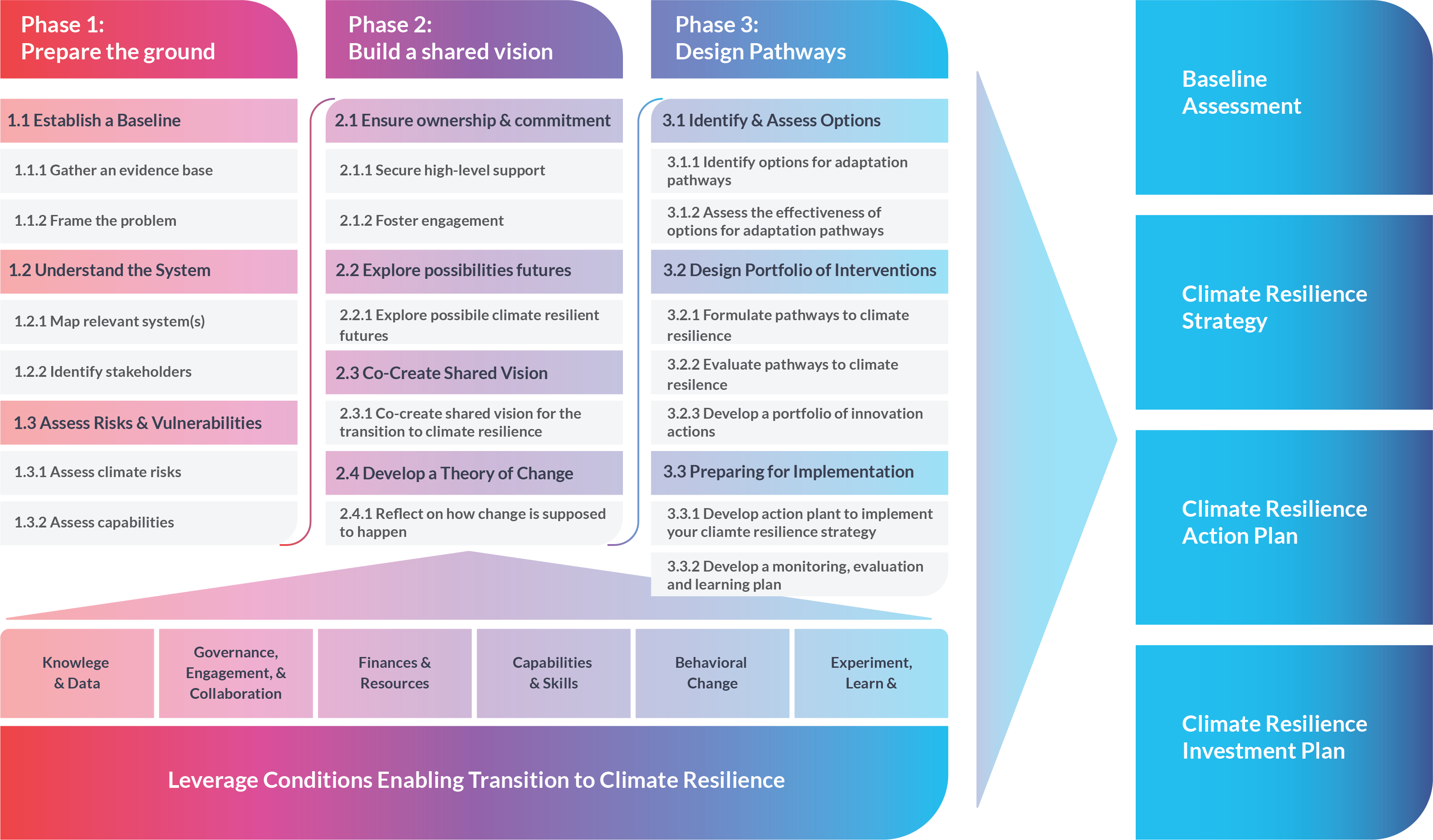
The Regional Resilience Journey (RRJ) framework
A systemic approach to accelerating climate resilience
Aiming at transformational adaptation, the RRJ inherently supports a systemic or systems approach, which, instead of breaking down the complexities of climate resilience to be considered as separate parts, encourages understanding and addressing this complexity with all its relevant parts and relationships in its entirety.
The RRJ should be applied taking into account the local context and building on what has already been achieved or is in motion. The RRJ should build on already developed strategies, revising and revisiting where relevant.
It is not necessary to use the RRJ as a whole new methodology, starting from scratch.
The RRJ approach ultimately provides the regions with the tools and methodologies to collect the necessary information to use the RRJ itself in the most strategic way possible, recognising that the local stakeholders are often the most knowledgeable on their own needs.
A just transition to climate resilience
The RRJ is designed to support regions and communities in a just transition to climate change, having integrated a range of principles, processes and practices that aim to ensure that no people, workers, places, sectors, countries or regions are left behind in the transition. As suggested by the IPCC (2022) regarding just transitions, it stresses the need for targeted and proactive measures to ensure that any negative social, environmental or economic impacts of economy-wide transitions are minimised, while benefits are maximised for those disproportionately affected.
Adaptation Investment Cycle
The Adaptation Investment Cycle helps to mobilise finance and ensure that the Regional Resilience Journey leads to bankable projects (i.e. those that meet the conditions required by the financier to finance a project).
The consortium has developed the Adaptation Investment Cycle – an iterative, 6-step process to develop Adaptation Investment Plans, designed to be completed as part of the Regional Resilience Journey.
The Cycle develops the financial aspects of a Climate Resilience Strategy from the identification of adaptation needs and barriers to finance all the way to the implementation and monitoring of efficient adaptation projects.
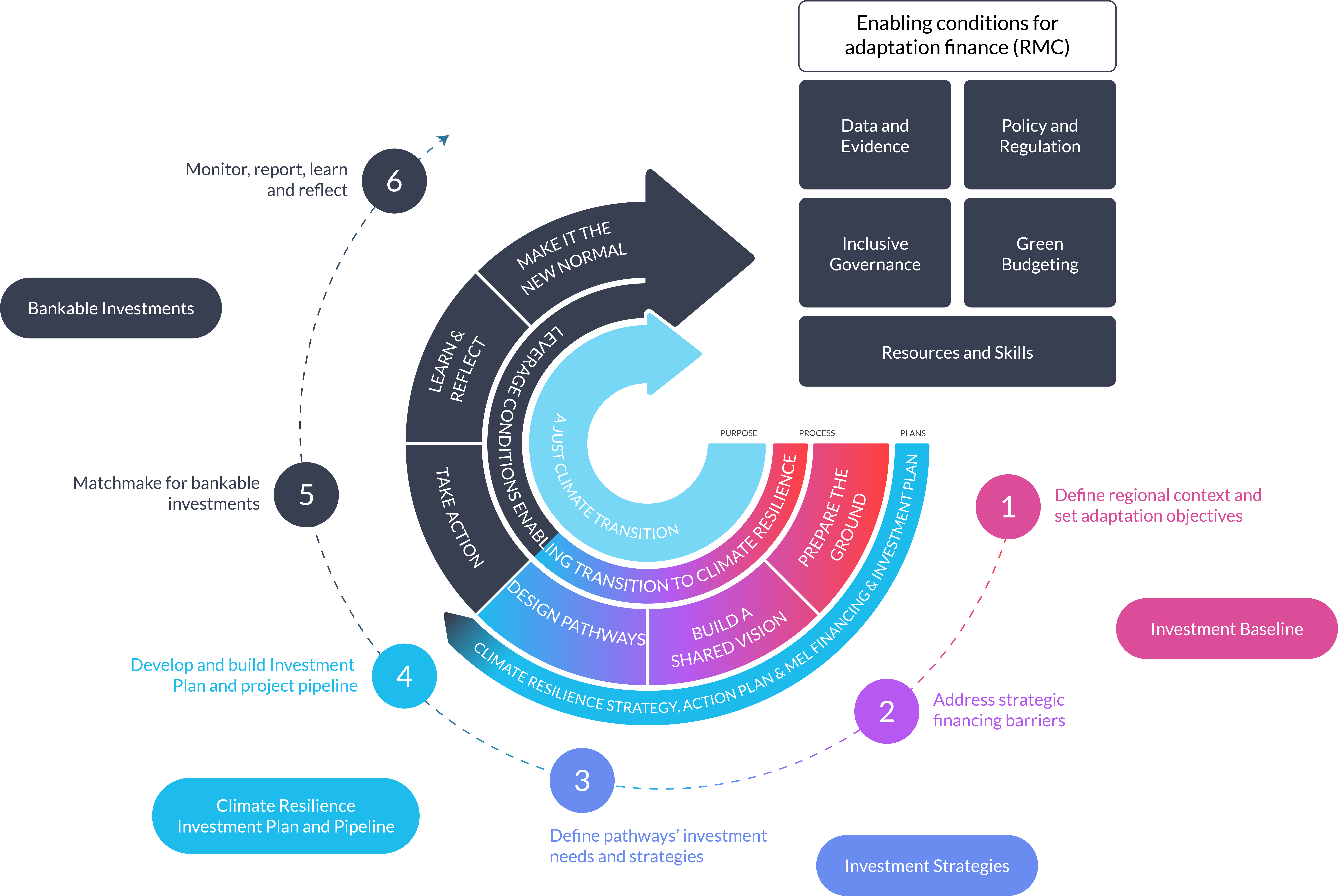
The Adaptation Investment Cycle (AIC)
Pathways2Resilience will be developing detailed guidance, resources, and templates to support the successful regions in applying the Adaptation Investment Cycle.
In the context of Pathways2Resilience’s work on regional adaptation finance, a Practitioner Finance Expert Working Group was assembled, acting as a liaison between regions and the broader financial assistance of Pathways2Resilience partners.
In addition, Pathways2Resilience will be developing a programme of training and capacity building, as well as working in depth with 9 regions across all levels of Maturity to provide tailored and targeted support.
Financial sources, instruments and best practice case studies to support financing regional adaptation
Pathways2Resilience has built a catalogue of 57 sources (institutions that provide finance for adaptation) and 78 financial instruments (mechanisms that enable the transfer of funds) for regions to use to support their adaptation efforts.
The catalogue includes a visual overview of sources and instruments, as well as detailed information on each, such as advantages and drawbacks, and key considerations for their use, as well as relevance to the Mission’s Key Community Systems.
In addition, the catalogue includes 169 case studies of public and private adaptation relevant to European regions. The elements of the catalogue can be filtered to meet your needs (e.g. by Key Community Systems, types of actors, typical funding sizes, financing strategies or hazards).
The catalogue can be used in isolation, but it has also been designed to support the P2R Adaptation Investment Cycle and help the development of Regional Climate Resilience Investment Plans.
Please find a draft of the Catalogue of sources and instruments and adaptation finance process (PDF)
Please find a draft of the Sources, Instruments and Best Practice Examples Catalogue (Excel)
The catalogue will continue to be developed and revised throughout the lifetime of the project. In addition, as part of the Mission, Pathways2Resilience is working with CLIMATEFIT – a project using Financing and Investment Taskforces in 20 Territories to create investment strategies, concrete and scalable investment plans, and bankable transformational investment cases. Together, the teams from both projects will develop and expand the catalogue. Planned enhancements include refining and expanding the definitions of sources and instruments, and the incorporation of an additional set of detailed case studies on financial instruments developed by CLIMATEFIT. We will also be hosting CLIMATEFIT’s more detailed deep-dive case studies on instruments when they become available.
Find out more about P2R Open Resources
We have prepared a range of guidance and support materials for the regions to follow the framework:
-
- Guidance on Developing Regional Resilience Investment Plans and Project Pipelines
- Regions4 contributed to this guidance and provided the following case studies in cooperation with Scotland and the region of Catalonia:
- Guidance on Developing Regional Resilience Investment Plans and Project Pipelines
-
-
-
- Case Study: Adaptation Scotland Guide to Adaptation Climate Finance
-
- Case study: Catalan Climate Fund: Using New Taxes to Fund Mitigation and Adaptation Activities
-
-
-
- The Self-assessment questionnaire: designed to assist public authorities working at the regional level in evaluating and monitoring their climate resilience capacities. It helps identify gaps and enhance preparedness for a climate-resilient future.
-
- The Pathways2Resilience Climate Toolbox: A repository of open-access resources, tools and materials to help participating regions in developing their climate resilience strategies, action plans and investment plans.
-
- The P2R Visual platform: Explore how communities across Europe are tackling climate challenges and building resilience. Click on the regions to uncover their unique story, milestones and progress.
-
- The Adaptation Finance Innovation Lab helps Pathways2Resilience participating regions design innovative finance mechanisms and business models tailored to their context, as well as providing advice on adaptation finance and innovation policy.
-
- The Capacity building programme: Being delivered on a monthly basis, generating a bunch of useful resources, reports and publications.
-
- We are in the process of establishing cross-mission exchange mechanisms, in collaboration with MIP4ADAPT/EC, and in the context of the Mission Adaptation’s FUTURIUMs Platform and their Thematic Working Groups (TWGs) and Communities of Practice (CoP), including:
-
-
- 4 Deep Dives: Deep Dives are communities of experts from different fields (including scientific, engagement, policy, and practice experts) aiming to exchange knowledge around key enabling conditions for climate resilience:
- Knowledge and data
- Governance, engagement and innovation
- Finances and resources, capabilities and skills
- Behavioural change
- 4 Deep Dives: Deep Dives are communities of experts from different fields (including scientific, engagement, policy, and practice experts) aiming to exchange knowledge around key enabling conditions for climate resilience:
-
We will be holding regular Deep Dive sessions on these topics, open to everyone, to generate insights and ideas to support the Pathways2Resilience participating regions further.
Particularly, Regions4 is co-leading the work on the Governance, Engagement and Innovation Deep Dive, in which we are working on a guidebook designed to support regional and local authorities in strengthening their climate adaptation efforts by leveraging this enabling condition that fosters collaboration, trust, and action across all levels of governance and society. By grounding the guidebook in more than 20 real case studies and opportunities faced by subnational governments, this document will provide a roadmap for integrating good governance practices and meaningful stakeholder engagement across the different phases of the P2R Regional Resilience Journey (RRJ).
-
-
- Innovation Practice Groups (IPGs): By participating in Pathways2Resilience, regions will have access to interactive working groups, organised by themes and involving a broad range of regional experts, citizen groups and practitioners.
-
-
-
-
- IPGs related to Key Enabling Conditions (KECs):
-
-
-
- Knowledge & Data
- Governance, Engagement & Collaboration
- Behavioural Change & Empowerment
- Finance & Resources
-
-
-
- IPGs related to Key Community Systems (KCSs):
-
-
-
- Ecosystems & Nature-Based Solutions
- Water Management
- Critical Infrastructure
- Land Use & Food Systems
- Health & Well-Being
- Local Economic Systems
Opportunities for Regions4 members in 2026-2027
Participate in the next round of IPGs Week on 19-23 October 2026 and in April 2027 (TBC). Find out more information here.
Meet the Regions and the Regions4 members participating
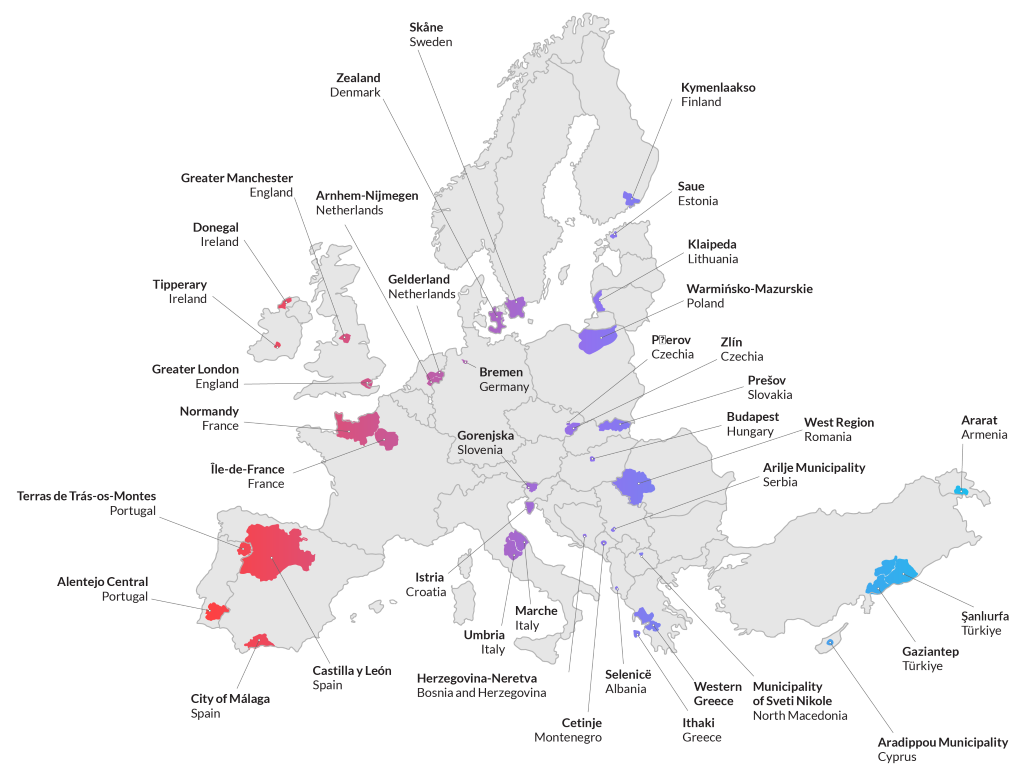
The 1st and 2nd calls for grants have aimed to provide 100 regions and communities with financial support through subgrant agreements, up to a maximum amount of 210,000€ for each region, along with supporting services and capacity-building activities for subgrants lasting up to 18 months.
The selection process took place in 2023 and 2025, and prioritised regions/communities with heightened vulnerability and low adaptive capacity to climate change impacts. These calls aim to put together a diverse and inclusive portfolio of regions, ensuring a comprehensive validation of the P2R framework.
We are thrilled to share that the Regions4 members of Ile-de-France, Catalonia, Košice, and La Réunion have been selected for the P2R programme.
Download the full list of selected regions here.
Get to know more about the P2R regions here.
>>> Take a look at the P2R past events and upcoming opportunities at the EU level.
>>> Learn more about the Pathways2Resilience project here.
Stay Tuned

Related Events
Join us!
We welcome our regions members to participate in EU Mission Horizon Europe Projects on Climate Change Adaptation
Do not hesitate to contact us!
Mariana Trinidad Corvaro, responsible
of this project:

Mariana Trinidad Corvaro
Climate and Resilience Project Manager
mcorvaro@regions4.org