Navigating water extremes: regions show how to govern and finance water resilience at COP31
As the UN 2026 Water Conference approaches (Abu Dhabi, 8–10 December), we’re bringing forward what regions told us at COP31 in Antalya: the climate and water agendas are the same agenda. At the Italian Pavilion at COP31 in Antalya, the Government of Lombardy and Regions4 brought together regional governments from three continents, the European Investment Bank and the Climate Champions team to discuss how regions turn science into action on droughts and floods, and how to unlock the finance to make it happen.
Climate change is pushing the water cycle to both extremes at once. In the same territory and the same year, regions now face droughts followed by extreme rainfall, floods and landslides. These risks do not stop at municipal borders: they run along river basins, from mountains and glaciers down into metropolitan areas.
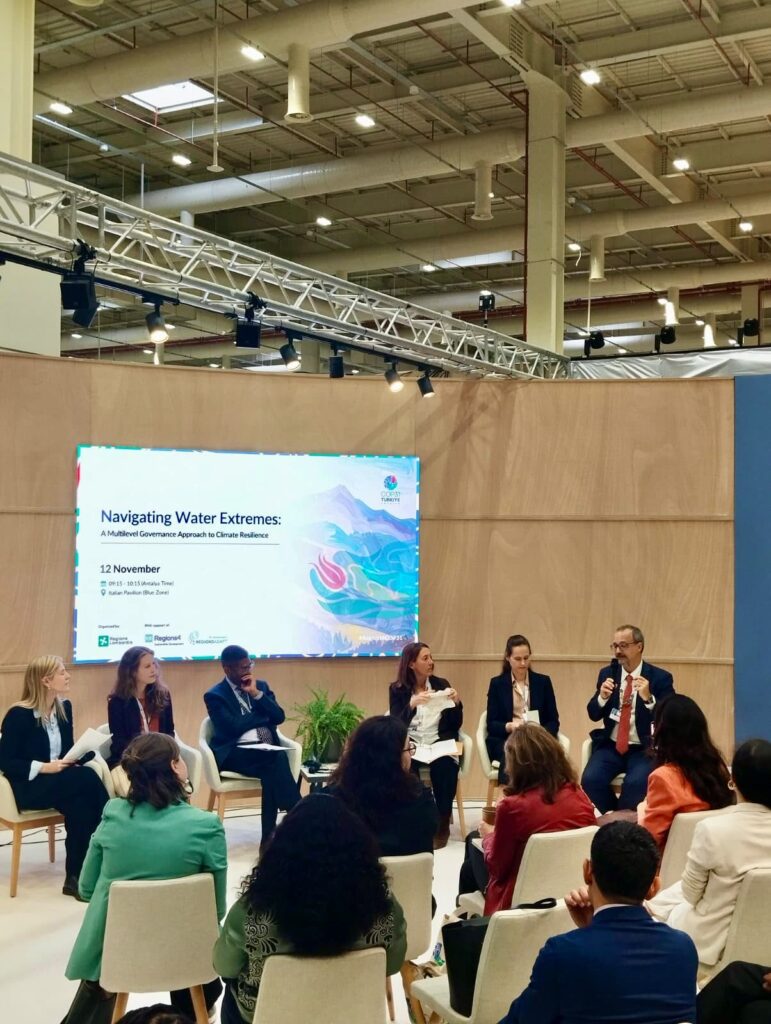
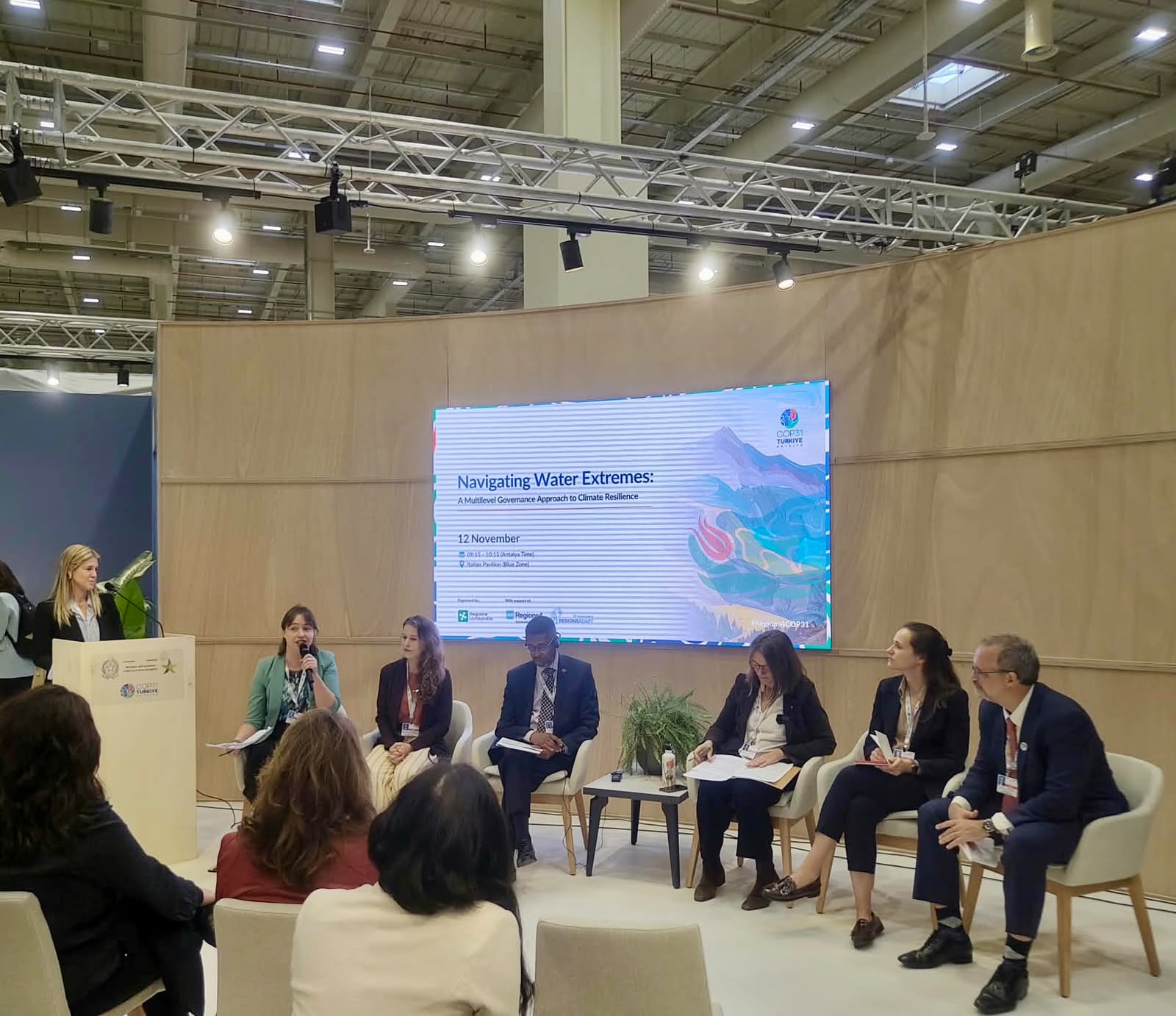
Regional governments operate at the scale where these risks have to be managed. On 12 November 2026, the side event “Navigating Water Extremes: A Multilevel Governance Approach to Climate Resilience”, co-organised by the Government of Lombardy and Regions4, explored their dual role: translating national climate commitments (NDCs) and adaptation plans into action on the ground, and coordinating across sectors and territories, from basin authorities and mountain communities to cities. The session was moderated by Mariana Corvaro, Climate Action and Resilience Project Manager at Regions4.
The session also highlighted a paradox. According to the OECD, subnational governments account for around 60% of climate-significant public expenditure and almost 70% of climate-significant public investment across OECD and EU countries, yet international adaptation finance still flows mainly through national channels, and regions remain among the least served by climate finance. The messages from the session will feed into the UN Water Conference in Abu Dhabi (8 to 10 December 2026) and the road to the IPCC Special Report on Climate Change and Cities in 2027.
LOMBARDY (ITALY): FROM WATER EMERGENCY MANAGEMENT TO WATER RESILIENCE GOVERNANCE
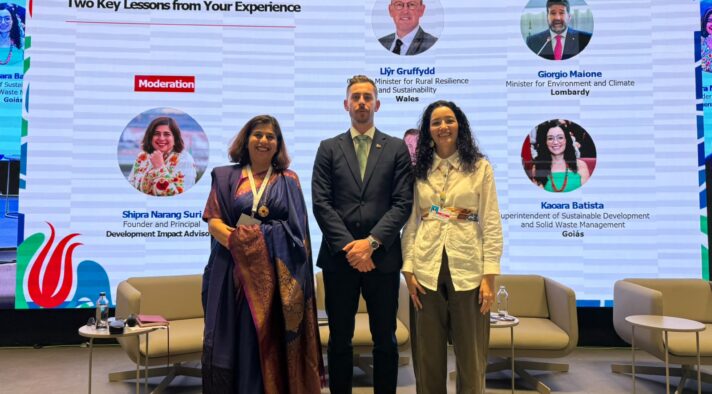
Opening the event, Giorgio Maione, Regional Minister for Environment and Climate of Lombardy, described a new climate normal of prolonged droughts, extreme weather events and an ever-closer alternation between water shortages and floods, which no longer allows for purely emergency-driven responses. The objective, he said, is to move from managing individual emergencies to the structural governance of water resilience.
Over the past five years, Lombardy has mobilised 800 million euros for the ecological transition, placing sustainability and climate adaptation at the heart of every budgetary and economic planning decision. This rests on two pillars: the Regional Climate Law, a comprehensive framework for carbon neutrality and risk mitigation, and the Integrated Regional Strategy for Adaptation to Climate Change (SIRACC), a scientific and operational tool that analyses 36 specific climate risks and integrates resilience into sectoral policies, from urban planning to biodiversity protection.
At the local level, the Green Streets (Strade Verdi) programme has deployed 20 million euros in regional resources in 2025 and 2026 to co-finance municipal projects for soil de-sealing, tree planting, ecological corridors and climate shelters. Lombardy is also investing in the efficiency of water and energy networks: the region accounts for 46% of the volume of district-heated buildings in Italy and 22% of the country’s hydroelectric production.
None of this, the Minister stressed, is possible without multilevel governance between the Ministry of the Environment, Regions, municipalities, River Basin Authorities, water service operators and the scientific community, an approach Lombardy puts into practice every day with ARPA Lombardia, the regional environmental protection agency, and the Lombardy Foundation for the Environment.
“Climate challenge is not won with announcements, but with the ability to translate strategic vision into construction sites, regulations and measurable investments.” Giorgio Maione, Lombardy (Italy)
PANEL 1: REGIONAL GOVERNMENTS AS CATALYSTS OF URBAN CLIMATE RESILIENCE
Goiás (Brazil): ecological restoration of critical water recharge areas
Carolina Stange Azevedo Moulin, Undersecretary for Biodiversity, Conservation, Water Security and Sanitation of Goiás, described Goiás as a state around four times the size of Portugal, covered by the Cerrado biome. Known as an “upside-down forest”, the Cerrado has deep roots that support water recharge and carbon storage. Rivers flowing north towards the Amazon, such as the Xingu and the Araguaia, are born there, and eight of Brazil’s twelve water basins begin in the Cerrado: it is the “cradle of waters”. Goiás is also an agricultural powerhouse, with some of Brazil’s largest soy and livestock production.
With two marked seasons, the state sees floods increasing year by year, especially in the capital Goiânia, and recurrent droughts, as precipitation becomes more irregular and concentrated. Paradoxically, the regions that suffer most from drought are also its main agricultural areas. Water governance in Brazil is participatory, through water basin committees where civil society and municipalities sit, and water has become an agenda that brings agriculture, livestock, industry and government to the same table.
Goiás runs a programme of ecological restoration in critical areas for water recharge, now in its fifth year, with a second programme in the modelling phase. Priority locations are mapped, and the state takes a non-punitive, voluntary approach: rather than pushing restoration costs onto landowners, who lack resources and, above all expertise in restoring a biome that science is still learning to restore, the state brings the knowledge, the team and the equipment. Around 1,000 hectares are being restored along the Araguaia, funded mostly by environmental compensation payments and fines, as well as donations. The state plans to scale up to other basins using revenue from water-use charges, a recently introduced instrument, although most funding still goes to the federal government rather than to the subnational governments that implement on the ground.
“Everybody sits at the table to talk about water. So it’s really an aggregating agenda.” Carolina Stange Azevedo Moulin, Goiás (Brazil)
KwaZulu-Natal (South Africa): upward and downward coordination
Rev. Musa Zondi, Member of the Executive Council (MEC) for Economic Development, Tourism and Environmental Affairs, explained that KwaZulu-Natal lives with both extremes: floods that have cost hundreds of lives, and droughts that have cut into the water supply of towns.
Upward, South Africa has a national framework for water: the President has launched a National Water Action Plan, driven by a National Water Crisis Committee that works directly with provinces and municipalities, and requires them to assess climate risks and prepare response plans aligned with the national adaptation strategy. The KwaZulu-Natal Climate Change and Sustainable Development Council brings provincial departments, municipalities, business, academia and civil society together so that provincial plans speak to these national commitments.
Downward, municipalities are the water services authorities. The province’s role is to support them and hold them to account, through the District Development Model, under which each district develops “one plan” that everybody acts on, for equity and fair distribution of water. Large bulk infrastructure is planned jointly by all three spheres of government (national, provincial and local), such as the Lower uMkhomazi Bulk Water Supply Scheme on the province’s South Coast and a bulk water supply scheme in the north.
“For us, resilience is not only an environmental question, it’s about the economy.” Rev. Musa Zondi, KwaZulu-Natal (South Africa)
PANEL 2: PAYING FOR RESULTS, UNLOCKING FINANCE FOR WATER AND ECOSYSTEM ADAPTATION
Catalonia (Spain): a financing gap of around 370 million euros a year
Sonsoles Letang, Director General for Climate Change and Environmental Quality of the Government of Catalonia, explained that Catalonia estimates the financing gap in its water sector at around 370 million euros per year. The total cost of water services is around 1.75 billion euros per year, and revenues cover only around 79% of it, leaving a gap of around 21%.
Revenues come from two main sources. The Catalan Water Levy, managed by the Catalan Water Agency (ACA), generates around 523 million euros per year, but most of it is already needed to operate the system, especially wastewater management. Municipalities also collect local water tariffs, but in many municipalities, especially smaller ones, these do not cover the real cost of maintaining networks. Over the last three years, the ACA has provided around 130 million euros to make municipal networks more efficient and reduce losses.
Climate change now adds new investment needs on top of maintaining the existing system: water reuse, desalination, more efficient networks and the protection of aquifers. This is why regional and local governments need better access to European and international finance, and innovative financing mechanisms.
“Our challenge now is double because we need to maintain and improve what we already have. And at the same time, we have to invest in a new water system […] more resilient to climate change.” Sonsoles Letang, Catalonia (Spain)
Rio de Janeiro (Brazil): water charges, oil royalties and a green VAT
Rodrigo Tostes de Alencar Mascarenhas, Secretary of State for the Environment and Sustainability, presented Rio de Janeiro’s financial instruments, within a participatory water resources system inspired by the French model, with river basin committees bringing together government, water users and civil society.
– Water Resources Fund: mobilises around 20 million annually from what companies pay for water abstraction. It is a public fund with democratic governance: allocation is decided through the participatory system, not by the Secretary. Rio adopted its state water resources law in 1999 and was the first Brazilian state to collect water charges in all its basins.
– State environmental fund: a budgetary fund that receives 5% of the state’s royalties from offshore oil exploration, around 200 million a year. Around 60% goes to the clean rivers programme (drainage, river cleaning and maintenance), which is key to preventing disasters during heavy rains.
– Atlantic Forest Fund: under federal law, 0.5% of the cost of large infrastructure projects subject to environmental licensing goes to biodiversity and protected areas. In 2009, Rio set up a mechanism, designed with the Brazilian Biodiversity Fund (FUNBIO), that deposits this money with a non-profit with sound governance: the state decides where the money goes, through a participatory process, but execution avoids the bureaucracy of the public budget.
– Green VAT (ICMS Ecológico): 25% of the state VAT goes to municipalities, part of it according to environmental criteria such as having an environmental department, sewage treatment and waste management, creating competition between municipalities to score more points.
“It is a public fund, but with a democratic governance. […] It works well because it really builds a sense of belonging in each river basin.” Rodrigo Tostes de Alencar Mascarenhas, Rio de Janeiro (Brazil)
European Investment Bank: closing the project preparation gap
Elina Väänänen, Climate Change Specialist at the European Investment Bank (EIB), made three points.
1. Close the project preparation gap. Cities and regional authorities know their priorities but still face significant barriers in turning them into a pipeline of bankable projects, so technical assistance is key. The City Climate Finance Gap Fund, implemented jointly by the EIB and the World Bank, bridges this “missing middle”. The EIB Group’s new Adaptation Plan Phase 2, presented at COP31, recognises the need to do more with cities and regions and commits at least 30 billion euros in adaptation finance between 2026 and 2030, double the amount of the previous five years.
2. There is no single financing instrument. Flood protection and ecosystem restoration rely strongly on public finance, but private approaches should be used where possible, and capital markets have a role: the EIB is part of the EU-led Global Green Bond Initiative helping first-time issuers integrate adaptation and resilience.
3. Co-create on climate risk assessment. The EIB can help bridge the gap between accessible, actionable climate data and investments on the ground. With the Copernicus Climate Change Service, it has developed ClimateSET, a free, open-access climate hazard exposure tool launching on 30 November, global in scope with more granular coverage in Europe at first.
“We need the full chain from financing, from risk assessment to project preparation, for us to get to scale.” Elina Väänänen, European Investment Bank
THREE TAKEAWAYS FOR THE GLOBAL CLIMATE ACTION AGENDA
Wrapping up, Ellie McBurney, Water Lead at the Climate Champions team, which supports the UN High-Level Climate Champions and the Global Climate Action Agenda, shared three takeaways, closely aligned with what the water initiatives she works with are experiencing:
1. Climate change compounds water risks. From Minister Maione’s “new normal” to the experiences shared by the panel, compounding risks are putting existing infrastructure under strain.
2. Water is the connector: between urban areas and the regions around them, the ecosystem services that support them, food systems and wider services.
3. Water also holds the solutions. Despite challenges such as bureaucracy, water is a strong connector to build the partnerships needed to link technical expertise with investment pipelines.
“Water has a very clear sort of lived experience for people and can also be a very strong connector to bring them together to have these partnerships that we so desperately need.” Ellie McBurney, Climate Champions team
FROM PLANNING TO BANKABLE INVESTMENT
The experiences of Lombardy (Italy), Goiás (Brazil), KwaZulu-Natal (South Africa), Catalonia (Spain) and Rio de Janeiro (Brazil) show that regions already have the science, the plans and the coordination mechanisms to manage water extremes. What they need now is direct access to finance and support to turn priorities into bankable projects. As moderator Mariana Corvaro put it, water may be one area where everyone can agree and move forward.