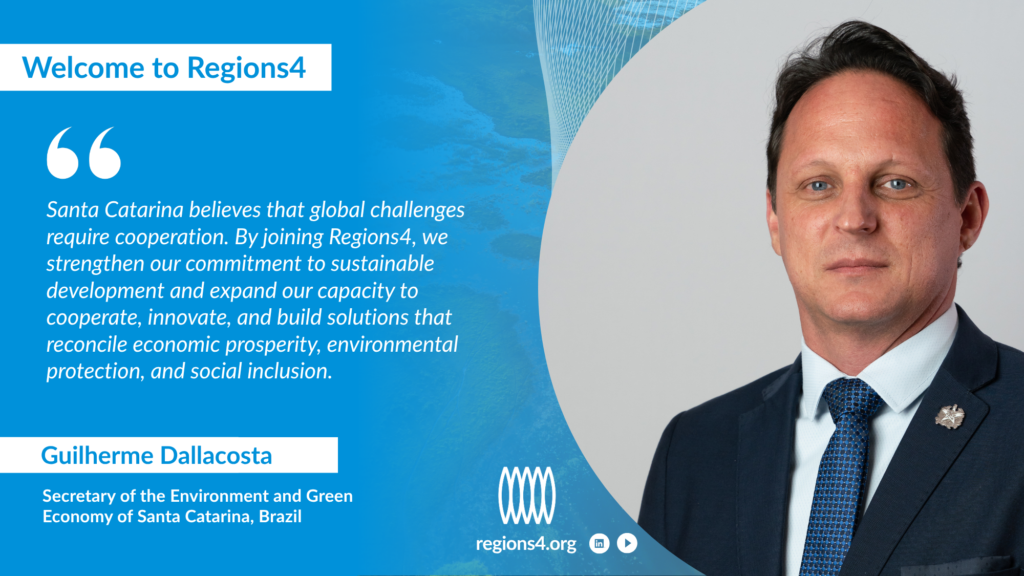
Welcome to Regions4: An Interview with the Secretary of the Environment and Green Economy of Santa Catarina, Guilherme Dallacosta
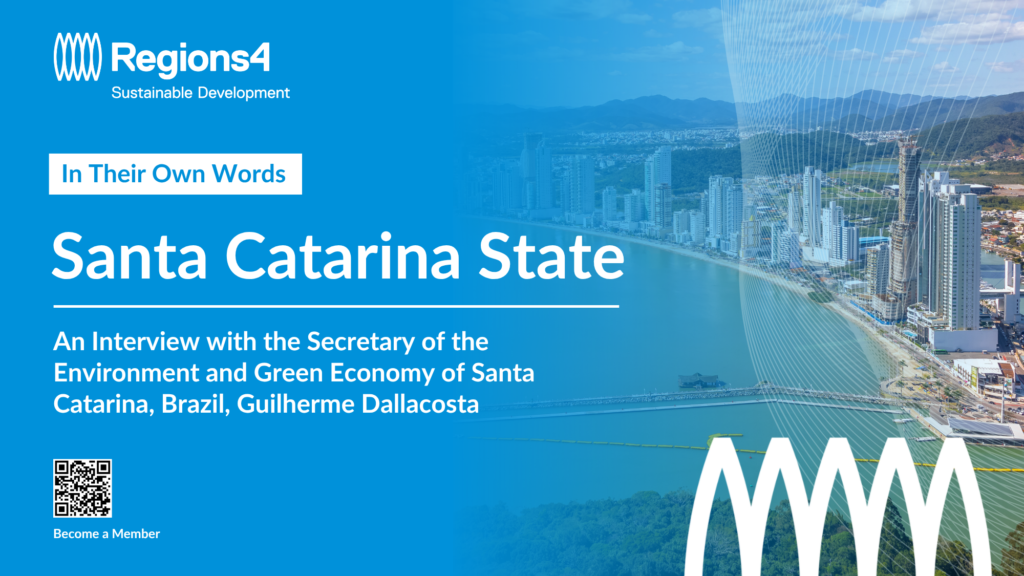
The Santa Catarina State Government, in Brazil, has positioned itself as a leading example of how economic competitiveness and environmental stewardship can advance together. In 2026, the Brazilian state joined Regions4, marking a new chapter in its efforts to promote sustainable development through green innovation, biodiversity conservation, and a just energy transition. In this edition of In Their Own Words, Secretary of the Environment and Green Economy Guilherme Dallacosta discusses the policies shaping Santa Catarina’s future and shares how participation in Regions4 will help the state strengthen international partnerships and contribute to global sustainability efforts.
1. What makes the state of Santa Catarina unique?
Santa Catarina is unique because it demonstrates that economic development and sustainability can go hand in hand. It is a state with a strong industrial, agricultural, and port economy, while also preserving one of the largest areas of native vegetation in Brazil and maintaining a well-established green economy model. A study conducted by the Government of Santa Catarina shows that the green economy generates approximately R$ 67 billion and supports about 775,000 jobs, representing one in four formal jobs in the state. This combination of competitiveness, innovation, and environmental conservation makes Santa Catarina a reference for long-term sustainable development.
2. What are the main sustainable development initiatives in your region?
The state’s strategy is based on the integration of environmental conservation, economic development, and innovation. Strategic initiatives include the Programa Mais Verde (Payment for Environmental Services), which rewards rural landowners who conserve native forests, and the modernization of the Cadastro Ambiental Rural (CAR) through CAR Digital. The state is also leading the Just Energy Transition Plan, a pioneering initiative in Brazil for incorporating social justice into economic decarbonization. Other initiatives focus on water resource management, the circular economy, and biodiversity conservation.
3. How does your region involve local communities and stakeholders in the implementation of sustainable development policies?
Social participation is a fundamental principle. Public policies are developed collaboratively, involving municipalities, universities, the private sector, and civil society from the planning stage through implementation.An example is the Just Energy Transition Plan, which has been developed through regional meetings and listening sessions held across the state. This participatory approach ensures that solutions are aligned with the needs and strengths of each region.
Public policies are developed collaboratively, involving municipalities, universities, the private sector, and civil society from the planning stage through implementation.
4. What are your expectations in joining Regions4?
Our goal is to become an active member of an international network committed to developing concrete solutions to global sustainability challenges. Santa Catarina expects to strengthen cooperation, share experiences, and learn from successful public policies implemented in other regions. At the same time, the state aims to contribute its expertise in the green economy and just energy transition while building strategic partnerships that promote sustainable development.
5. Are there specific areas of Regions4 where you see immediate opportunities for collaboration?
There are significant opportunities for collaboration in the areas of the green economy, climate change adaptation, biodiversity conservation, and energy transition. There is also strong interest in technical cooperation to exchange methodologies, indicators, and financing instruments that can accelerate the implementation of sustainable public policies. Sharing experiences with regions facing similar challenges will help generate more efficient and innovative solutions.
6. What knowledge or experience do you hope to share with other members of Regions4?
Santa Catarina can share its methodology for measuring the green economy, which assesses its contribution to GDP and employment. Other experiences we can share include the Programa Mais Verde, digital platforms for environmental regularization, and our model for a just energy transition based on dialogue and social inclusion. These initiatives can inspire other regions while also being strengthened through international cooperation.
7. How do you intend to leverage your membership of Regions4 to increase your region’s visibility and influence on the global stage?
Participation in Regions4 will position Santa Catarina as an international reference for sustainable development based on concrete results. The state seeks to expand partnerships, attract technical cooperation and investments for the green economy, and increase the visibility of its local solutions. Furthermore, learning from other regions will strengthen local public policies while enabling Santa Catarina to contribute actively to global discussions on sustainability.