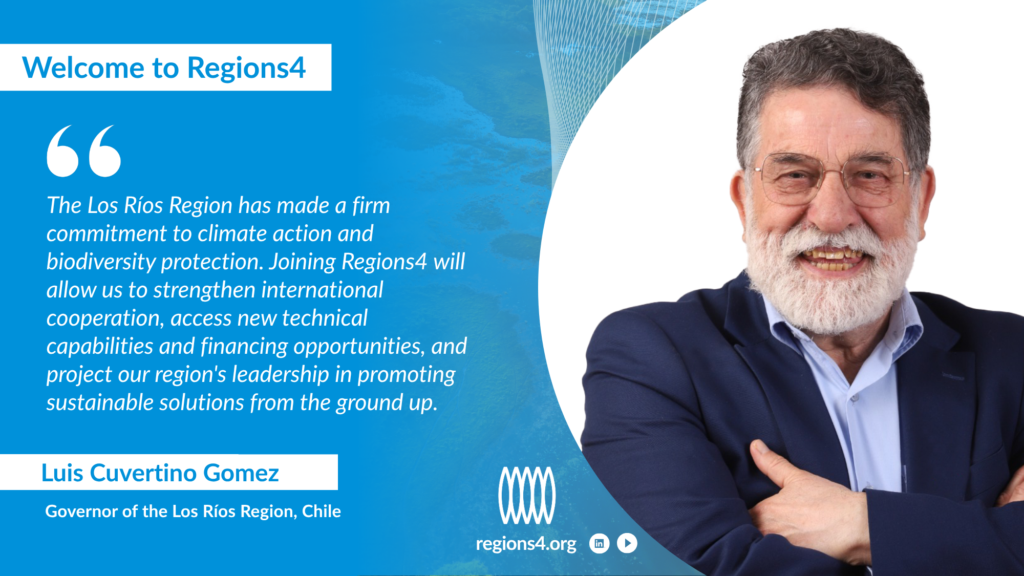
Welcome to Regions4: An Interview with the Governor of Los Ríos Region, Luis Cuvertino Gómez
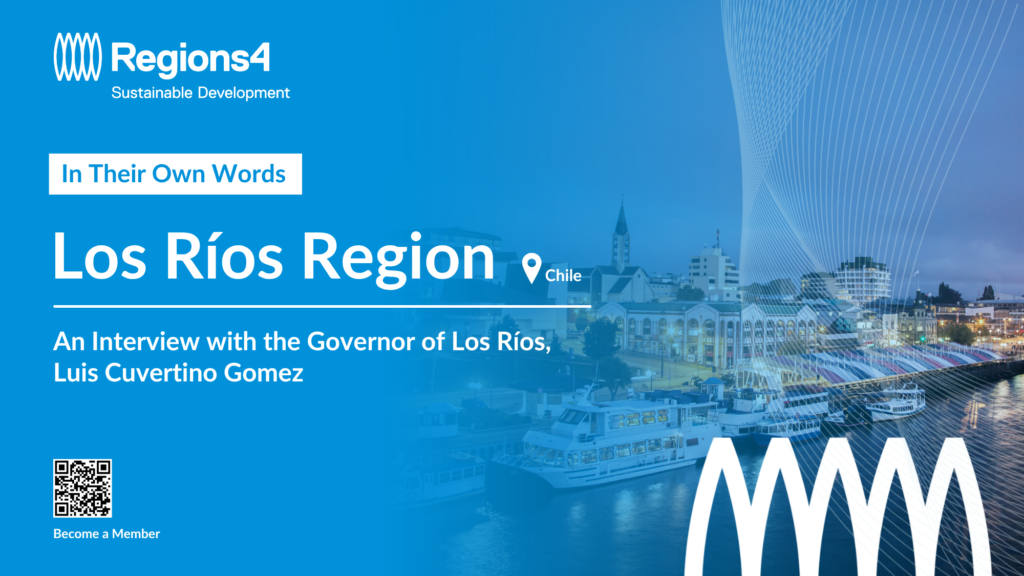
In 2026, the Los Ríos Region, in Chile, joined Regions4, marking a new milestone in its commitment to sustainable development and climate action. Home to a rich natural heritage of temperate forests, rivers, wetlands and coastal ecosystems, the region has positioned itself as a national leader in climate planning, becoming the first region in Chile to adopt a Regional Climate Change Action Plan. Through initiatives focused on ecosystem restoration, water governance and nature-based solutions, Los Ríos is working to reconcile biodiversity conservation with the well-being of its communities. In this edition of In Their Own Words, Governor Luis Cuvertino Gómez reflects on the region’s vision for a more resilient and sustainable future, and on how joining Regions4 will strengthen Los Ríos’ international partnerships and amplify its voice in global discussions on climate and nature.
1. What is unique about the Los Ríos Region, in Chile?
The Los Ríos Region has a unique natural heritage, where temperate forests, rivers, wetlands and the coastline combine to form a territory of immense environmental and cultural value. This wealth has shaped our identity and also our understanding of sustainable development: we believe that economic growth, the protection of biodiversity and people’s well-being must go hand in hand.
As the Regional Government, we have taken up this challenge by promoting an agenda that integrates spatial planning, climate action, sustainable water management and ecosystem conservation, positioning Los Ríos as a region that seeks to transform its natural heritage into an opportunity for sustainable development for future generations.
2. What are the main sustainable development initiatives in your region?
One example is the Regional Climate Change Action Plan (PARCC), where the Los Ríos Region pioneered the way by becoming the first in the country to adopt this instrument. Furthermore, all 12 municipalities have their own municipal plans, strengthening spatial planning and the capacity to adapt to climate change. A second example is the Regional Water Board, promoted by the Regional Government to tackle the challenges of water security through collaborative governance. This work gave rise to the Native Forest Restoration Plan, with an emphasis on the ecosystem service of water, which aims to protect catchment areas, conserve biodiversity and strengthen the resilience of communities through nature-based solutions.
3. What are the most pressing challenges in terms of sustainable development and the environment facing your region?
The Los Ríos Region faces significant challenges linked to climate change, biodiversity protection and water security. Our main challenge is to move from planning towards the implementation of concrete actions that strengthen the resilience of our territories and improve people’s quality of life. As the Regional Government, our priorities are to implement the Regional Climate Change Action Plan (PARCC), promote the restoration of strategic ecosystems, strengthen water governance through the Regional Water Board, and consolidate national and international partnerships that will enable us to accelerate sustainable development with a distinct regional identity.
4. How does your region engage with local communities and stakeholders in the implementation of sustainable development policies?
The participation of local stakeholders is a fundamental principle of our administration. As the Regional Government, we promote collaborative governance that brings together local authorities, public services, local communities, indigenous peoples, academia, civil society organisations and the private sector in the design and implementation of key regional planning policies and instruments, such as the Regional Development Strategy and the Regional Climate Change Action Plan. A concrete example is the Regional Water Roundtable, a permanent forum where these stakeholders develop solutions to strengthen water security. This process led to the Native Forest Restoration Plan, with a focus on the water ecosystem service – an initiative that demonstrates how working together enables us to protect our ecosystems and generate tangible benefits for communities.
5. What are your expectations in joining Regions4?
Our membership of Regions4 represents an opportunity to strengthen the implementation of the policies we are already promoting in the Los Ríos Region.
We hope to gain access to technical cooperation, exchange experiences with other regions and generate new funding opportunities that will accelerate projects linked to climate action, biodiversity conservation and sustainable water management.
At the same time, we want to share the expertise we have developed as a region in areas such as climate planning and territorial governance, positioning Los Ríos as a benchmark for sustainable development. We are convinced that this exchange of knowledge and best practice will enable us to respond more effectively to environmental challenges and generate tangible benefits for our communities.
6. Are there specific areas of Regions4 where you see immediate opportunities for collaboration?
We see immediate opportunities to collaborate with other regions in areas such as climate change adaptation, biodiversity conservation, ecosystem restoration and integrated water management. Initiatives such as the RegionsAdapt, RegionsWithNature and other Regions4 platforms will provide a valuable opportunity to exchange experiences, develop joint projects and access technical and financial cooperation. Our aim is to build partnerships that will enable us to accelerate the implementation of our regional policies whilst, at the same time, sharing the expertise that Los Ríos has developed in climate planning, territorial governance and nature-based solutions.
7. What expertise or partnerships are you seeking through Regions4?
The Los Ríos Region has a robust framework for climate change and sustainable development planning. Our challenge is to accelerate its implementation by strengthening technical capacities, access to international cooperation and funding for projects with a territorial impact. Through Regions4, we aim to exchange knowledge with other regions, forge partnerships with international organisations and sub-national governments, gain access to tools that strengthen our public policies, and promote initiatives on climate change adaptation, biodiversity conservation, water security and nature-based solutions.
8. How do you intend to leverage your membership of Regions4 to increase your region’s visibility and influence on the global stage?
We want to position the Los Ríos Region as a leader in sustainable development, climate action and biodiversity conservation. Our participation in Regions4 will enable us to share the expertise we have built up in climate planning, water governance and territorial management, whilst learning from other regions facing similar challenges. This membership will strengthen our presence on the international stage, open up new opportunities for cooperation and funding, and help position Los Ríos as a region that drives innovative, locally-led solutions to tackle the global challenges of climate change and sustainable development.