10 Years of RegionsAdapt: “Without Regions, Adaptation Stays on Paper”
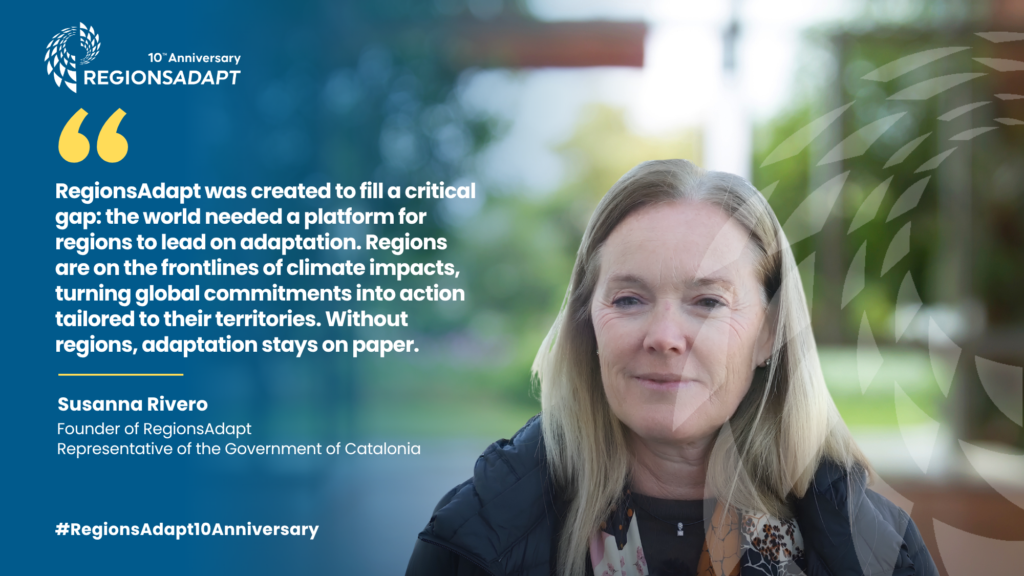
As RegionsAdapt marks its 10th anniversary, we look back at the initiative’s origins and the need that led to its creation. Launched at the United Nations Climate Change Conference in Paris (COP21) by the Governments of Rio de Janeiro and Catalonia, with the support of Regions4, RegionsAdapt was created to strengthen cooperation among states and regions on climate adaptation and provide a platform to exchange knowledge, share solutions and advance action on the ground. Over the past decade, the initiative has grown into a global network of subnational governments working to build more resilient territories. We spoke with Susanna Rivero, Foreign Affairs Manager at the Government of Catalonia and one of the founders of RegionsAdapt, about how it all began and the role of regions in delivering climate adaptation.
When and why did RegionsAdapt come to exist?
RegionsAdapt was created in 2015, in the run-up to COP21, when subnationals aimed to build momentum and contribute with their own climate pledges.
At the time, the Paris Agreement was heavily focused on mitigation, leaving a gap on adaptation and subnational action. There was no platform for subnational governments to work together on climate adaptation.
As you know, regions manage territories that are directly affected by droughts, water scarcity, heatwaves, fires and many other climate impacts, yet they often lacked both a voice and the tools to respond effectively. RegionsAdapt filled that gap as the world’s first initiative for regional climate adaptation, providing a platform for adaptation planning, best practice exchange, and reporting.
Subnationals are frontline actors, turning global commitments and policy into territory-specific action. Without regions, adaptation stays on paper. We’re the bridge between international ambition and real territorial resilience.
Looking back over the past decade, what has RegionsAdapt achieved?
RegionsAdapt has mobilized more than 85 regions across 5 continents, reaching more than 470 million people through knowledge exchange, tool sharing, annual reports, and also by joining the UN Race to Resilience campaign.
Over the past ten years, it has bridged the gap from planning to action, proving the regional leadership in climate adaptation.
One key achievement has been positioning RegionsAdapt as a global benchmark for subnational adaptation, supporting subnational governments in identifying impacts, developing adaptation plans, tracking progress, and also igniting innovation.
It has also contributed to raising the voice of subnational governments in the international agenda, showing that adaptation without subnational governments simply doesn’t scale.
What should be the priority for the next decade of climate adaptation?
The next step must move beyond commitments, assessments, plan, actions, and reporting towards massive investments in resilient infrastructure, agriculture, and climate risk mangagement. We must prioritize direct finance for subnationals so they can implement adaptation where it matters most.
As Regions4 Ambassador, I envision RegionsAdapt becoming a pillar of the global adaptation agenda, leading on subnational finance and North-South alliances.
I invite regional governments around the world to join RegionsAdapt, turning adaptation from plan to real impact for millions of people.