10 Years of RegionsAdapt: How a Shared Vision Became a Global Movement for Climate Adaptation
As RegionsAdapt marks its 10th anniversary, we look back at the start of the initiative and the motivations behind its creation. Launched at the United Nations Climate Change Conference in Paris (COP21), RegionsAdapt was initiated by two representatives from the Government of Rio de Janeiro and the Government of Catalonia, with the support from Regions4. It has since grown into a global initiative supported by subnational governments around the world, including the Government of Québec. We spoke with Pedro Spadale, Head of International Relations at the Federal University of Rio de Janeiro and one of the founders of RegionsAdapt, about how it all began.
What led to the idea of creating RegionsAdapt?
The idea of fostering a global initiative related to adaptation was born in the state government of Rio de Janeiro, in Brazil.
The experience of major natural disasters was a starting point. In April 2010, a major disaster occurred in the State of Rio de Janeiro, whre floods and mudslides resulted in more than 200 victims. In January 2011, another disaster followed, with more than 900 victims, making it the worst natural disaster in Brazilian history at that time.
At that moment, preventing the impact of extreme climate events became a top priority for the government of Rio de Janeiro, which began looking at successful approaches implemented elsewhere. It was then we realised that subnational climate discussions were largely focused on mitigation at that time.
What was the original concept behind RegionsAdapt?
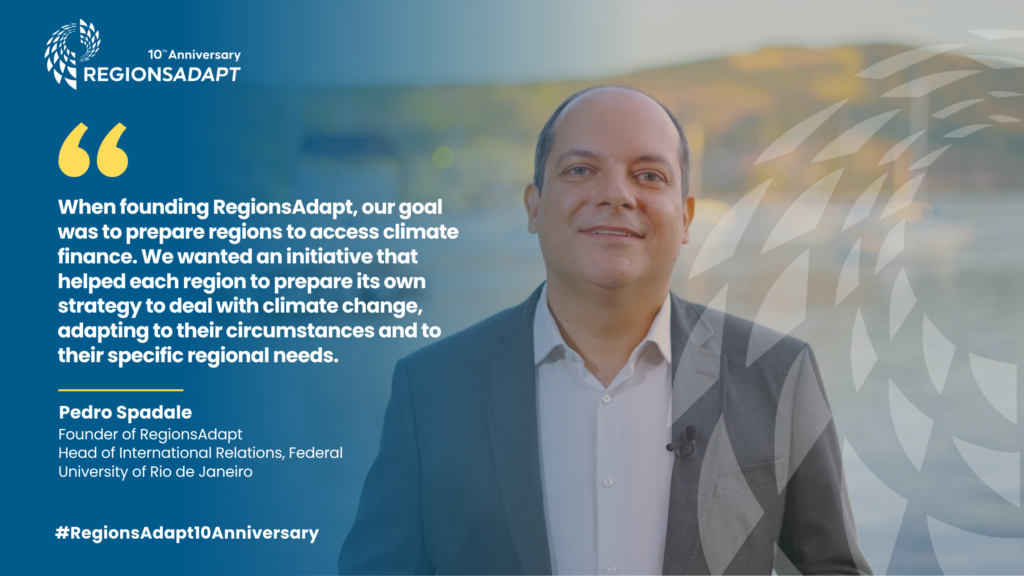
The concept was to prepare regions to be ready to adapt to climate change and, ultimately, to access climate finance. At the time, there were discussions about the creation of a global adaptation fund and the need for countries and subnational governments to be prepared for new financing opportunities.
A key idea was that, to access climate finance, funders first need to see that regions have a clear understanding of their climate risks, adaptation priorities, and a credible plan to address them. In this sense, RegionsAdapt was designed to support regions in climate adaptation planning, helping them assess their vulnerabilities, identify their needs, and develop strategic adaptation priorities. This planning process would then put them in a stronger position to pursue future funding opportunities.
Regional governments therefore needed to be ready for this new reality, both in terms of climate change impacts and positioning themselves for future finance.
The idea was also to avoid a one-size-fits-all approach, and instead support each region in developing its own strategy to address climate change according to its circumstances, priorities and needs.
How did RegionsAdapt develop at the international level?
RegionsAdapt was launched in Paris during COP21 with 27 founding regions. It was designed as a space for a community of practice and peer-to-peer exchange of solutions that are tested and implemented in different contexts. Over the past ten years, it has grown into a global movement of more than 85 member regions committed to advancing climate adaptation.
The initiative also aimed to support capacity building, which is considered important for states and regions to prepare plans and access finance for programmes and projects.
Over the past decade, RegionsAdapt has delivered nearly 55 online Communities of Practice and organised around 60 in-person climate events, fostering continuous knowledge exchange, peer learning, and collaboration among regional governments worldwide.
Why is the regional level important for adaptation?
States and regions are important for adaptation because it is necessary to consider climate impacts at a regional scale. Adaptation cannot be addressed only through small parts of a territory, such as cities, because it is an integrated phenomenon.
This includes water treatment, water management, and the connection between rural, peri-urban, and urban areas and regional and state governments are the ones that understand these intersections as well as the needs within their territories. Their role is to bring municipalities and cities together to prepare the territory for climate change.
How would you describe the evolution of RegionsAdapt?
After 10 years, RegionsAdapt has successfuly supported regions in adapting to climate change. It has also deepened collaboration with other partner initiatives to support states and regions in preparing for future challenges.
As RegionsAdapt enters its second decade, the focus is on continuing to support regions in developing and implementing their adaptation plans, while helping those that are ready to move forward access the finance needed to turn ambition into action.
We invite more regions and partners to join us in accelerating climate adaptation worldwide.