How Scotland Is Preparing for Climate Change: a Just and Measurable Adaptation Plan
Scotland, United KingdomThe RegionsAdapt Spotlight Series highlights how regional governments are transforming adaptation strategies into concrete action. This session featured the Government of Scotland and its Third Scottish National Adaptation Plan (SNAP3), a comprehensive roadmap for climate resilience covering 2024–2029.

A Legally Anchored response to escalating risks
Scotland is already facing accelerating climate impacts, with its ten warmest years recorded since 1997, 2025 now confirmed as the warmest year on record, over 60 named storms since 2015, and winters now 25% wetter than mid-20th-century averages. In response, the Scottish Government launched its third Scottish National Adaptation Plan (SNAP3, 2024–2029), the country’s most ambitious adaptation framework to date, addressing 61 climate risks and opportunities identified through the UK Climate Change Risk Assessment. Adaptation planning is anchored in law, with the 2009 Scotland Climate Change Act requiring a new plan every five years aligned to the cycle for new Climate Change Risk Assessments, ensuring continuity and political accountability.
The Adaptation Plan sets out support for communities, public services, businesses and nature to adapt to the changing climate in a way that is just and inclusive.
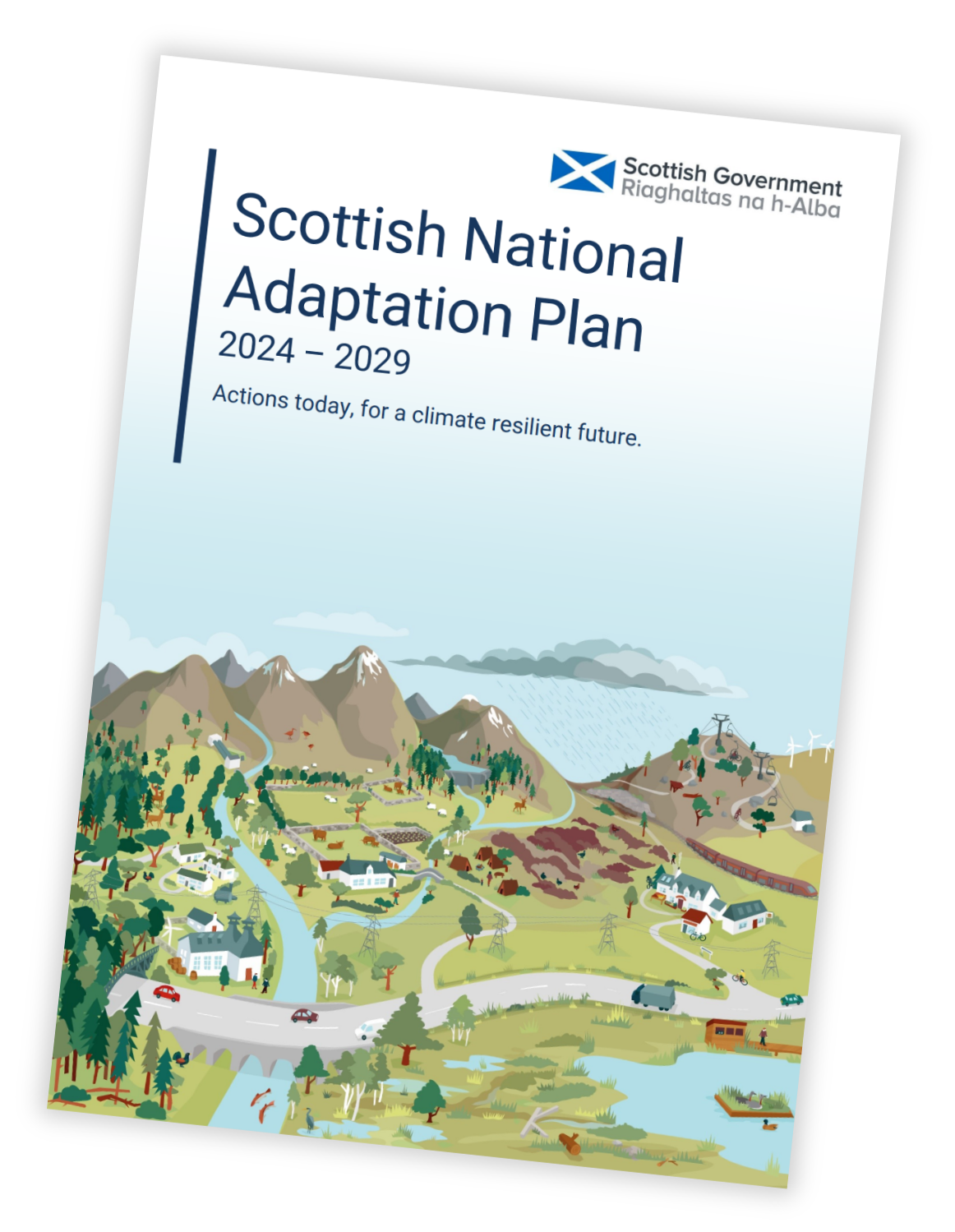
The Core Features of the Scottish National Adaptation Plan
The Scottish National Adaptation Plan represents a major shift in Scotland’s approach to climate resilience, moving beyond a primarily environmental lens to a whole-of-government and whole-of-society strategy spanning national and local government and the wider public sector. The latest Adaptation Plan also benefits from clear governance and a monitoring process for climate resilience:
- Five Strategic Outcomes: The plan is structured around five long-term outcomes covering the natural environment, communities, public services and infrastructure, the economy, and Scotland’s international role. These are supported by 23 short-term objectives to be delivered by 2029.
- Place-Based and Inclusive Action: At the heart of the Plan, is the belief that adaptation must be locally led to be effective. Scotland is expanding its regional adaptation partnerships to cover the entire country by 2029, and over 24 Community Climate Action Hubs supporting local action, backed by tools and facilitation by the Scottish Government-funded Adaptation Scotland programme. Adaptation Scotland. To ensure inclusivity, the government published Gaelic language and children’s versions of the plan.
- Natural Solutions: Climate adaptation and biodiversity policy are closely aligned, with around one-quarter of the Plan’s actions included in the Scottish Biodiversity Delivery Plan, including peatland restoration, marine protected areas, invasive non-native species control, and flood management. Other key measures include directing 50% of agricultural support towards climate and nature outcomes, and ensuring nature restoration at scale such as the Nature 30 initiative (30% protected areas by 2030), and flagship catchment projects such as the River Leven restoration, delivering flood protection alongside community health benefits.
- A First-of-its-Kind Monitoring Framework: For the first time, Scotland has introduced a Monitoring and Evaluation (M&E) framework that utilizes “monitoring maps” to track progress. The framework includes 38 objective-level indicators reported on annually to ensure quantifiable transparency. This is the first adaptation monitoring framework in the UK.
Mobilising Finance for Adaptation
Despite strong governance and planning, financing remains one of the biggest challenges. Scotland estimates an adaptation investment gap of £980 million to £3.9 billion by 2030, highlighting the need for blended public and private finance.
Several innovations are being tested, including climate budget tagging, pilots of blended finance models for peatland restoration, and a Natural Capital Market Framework to guide responsible private investment. The Scottish National Investment Bank also requires investees to complete a Climate Resilience Checklist. In addition, the Facility for Investment Ready Nature Scotland (FIRNS) supports the development of natural capital markets by building a pipeline of investable nature-based solutions, developing tools such as codes and standards, and enabling project aggregation to attract investors. To date, FIRNS has mobilised £4.75 million across 28 projects.
Further work is underway on adaptation cost forecasting, a public–private finance taskforce, nature investment prospectuses, biodiversity credits, and blended finance pilots, particularly for peatland restoration.
© The Scottish Government
Key Lessons for Regions Starting Their Journey
For subnational governments beginning their own adaptation planning, Scotland’s experience offers several insights:
- Mainstream through Governance: Embedding adaptation beyond the environmental “silo” requires strong governance, statutory reporting duties, and clear accountability. The Scottish National Adaptation Plan assigns senior accountable officers and lead directorates to every objective, driving cross-sector ownership.
- Maintain Structural Consistency: Adopting a clear framework -such as an objective-based approach- and maintaining it over time helps stakeholders, auditors, and the public track progress as plans mature.
- Empower Communities through “Climate Action Hubs”: To bridge the gap between national policy and local reality, Scotland established 24 community climate action hubs to empower local people with training and seed funding, ensuring they feel in control of their lives even as the climate changes.
- Connect early with research networks: Monitoring a “lack of events” (such as a house not flooding) is a complex analytical challenge. Early collaboration with researchers and economists helps guide decisions by shaping the design of indicators and financial analysis.
- Tackle Biodiversity and Climate Together: Nature-based solutions and wider nature restoration provides multiple benefits for the environment, the economy, and public health. Projects that address these crises simultaneously are more likely to gain local buy-in and deliver long-term resilience.
By moving from high-level ideas to measurable implementation, The Scottish National Adaptation Plan provides a strategic blueprint for any region looking to turn climate risks into opportunities for a more resilient future.
- The Scottish National Adaptation website
- Home – Adaptation Scotland
- The Scottish National Adaptation Plan Presentation
- Scottish National Adaptation Plan: Annual Progress Report 2024-25
- SNAP3 Monitoring and Evaluation Framework
- Climate Change Risk Assessment Independent Assessment (CCRA4-IA) Technical Report – UK Met Office
This experience was shared during a RegionsAdapt Spotlight session, which offers an in-depth look at how one regional government is planning and delivering climate adaptation on the ground, with the aim of inspiring and informing action across regional governments worldwide. RegionsAdapt is Regions4’s flagship initiative supporting regions to advance ambitious climate adaptation planning and action.
More actions in this region
Aligning biodiversity and climate policy for resilient communities in Scotland
Scotland, United Kingdom Scotland is aligning biodiversity and climate policy to strengthen resilience in
How Scotland Is Preparing for Climate Change: a Just and Measurable Adaptation Plan
Scotland, United Kingdom The RegionsAdapt Spotlight Series highlights how regional governments are transforming adaptation- Peatland Restoration

Scotland’s Peatland ‘The Flow Country’ wins UNESCO’s World Heritage Status
Scotland, Scotland In a groundbreaking achievement for Scotland and the world, The Flow