From Waste to Resource: How States and Regions Are Leading on Zero Waste
Goiás, Brazil, Cameroon, Canada, SpainStories from states and regions for the Global Climate Action Agenda
What we throw away is a climate issue. Food rotting in landfills releases methane, a gas that is about 80 times more potent at warming than CO₂ over 20 years. And every product we discard means new materials must be extracted, processed and shipped, often at a high carbon cost.
In June 2026, the incoming COP31 Presidency made zero waste a priority of the Global Climate Action Agenda. It set two goals: halve the growth in global waste by 2035, and make sure at least 15% of the materials the world uses come from recycled or recovered sources. It also launched a new Zero Waste Districts Initiative.
Much of this work happens closer to home. States and regions often run or oversee waste collection, landfills, local industry and support for businesses. Members of RegionsAdapt, the global initiative of regional governments committed to climate action, are already showing what success looks like, in three areas.
1. Keeping food waste out of landfill to cut methane
Tackling food and organic waste is one of the cheapest and fastest ways to cut methane. Leading regions now treat it as essential public infrastructure, like water or roads, rather than an optional extra.
Wales (United Kingdom): from 5% recycling to second in the world
When Wales gained its own government in 1999, it recycled around 5% of its waste and sent about 95% to landfill. In 2024-25, it recycled 68.4% of municipal waste and sent just 0.7% to landfill, second in the world behind only Austria.
Food waste is central to this success. Every household has had a separate food waste collection since the mid-2010s, and since April 2024 so has every workplace producing more than 5kg a week. Separated food waste is also banned from landfill, incineration and the sewer. The lesson: steady, long-term commitment pays off. Read more. Explore stats.
Québec (Canada): making landfill pay for its alternatives
Québec has cut greenhouse gas emissions from its landfills by 45.6% since 1990, and emissions from the waste sector as a whole by 40%, using three tools that reinforce each other:
- A fee on landfill. Every tonne sent to disposal is charged, funding facilities that compost food waste or turn it into biogas.
- Rules on landfill gas. Regulations require landfills to capture the gases they release.
- The carbon market. Projects that capture, destroy or reuse landfill methane can earn carbon credits.
Learn more (in French): [links to add]
Casablanca-Settat (Morocco): cleaning up a legacy landfill
At Médiouna, Casablanca-Settat Region is pairing a new waste treatment centre, designed for up to 1.5 million tonnes of waste a year, with the clean-up of the old landfill. Methane from the landfill is captured to generate 4 MW of biogas power, and the rehabilitated site is being turned into a 40-hectare public park. The centre will also recover energy from residual waste, with a capacity of 115 MW, and is complemented by 50 MW of solar power.
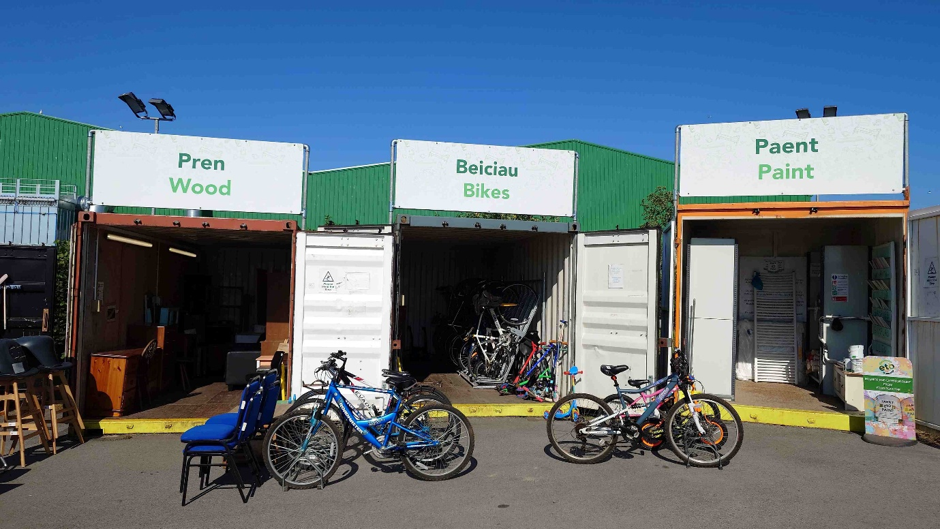
Canolfan Eto – “Wales’ Largest Reuse Village!” at the CWM Environmental site at Nantycaws in Carmarthenshire (Photo: Andy Rees)
2. Building economies that keep materials in use
A circular economy keeps products and materials in use for as long as possible. Reaching the 15% global target will depend on regions reshaping the sectors that use the most resources, and putting the laws and funding in place to make it last.
Paris Region (France): rethinking how we build
Construction is one of the most resource-hungry sectors in the world and one of the largest sources of waste. The Paris Region’s BTP circulaire programme backs projects that reuse or recycle building materials instead of throwing them away. The projects supported are expected to reuse or recycle nearly 700,000 tonnes of construction waste over their lifetimes, avoiding more than 325,000 tonnes of CO₂e a year. Read more.
Catalonia (Spain): a whole textile value chain behind one agreement
Catalonia’s Circular Fashion Agreement brings together 140 organisations across fashion, home and technical textiles. It aims to cut textile waste by 5–10% and reach 30% separate collection by 2029, with 55–60% of what is collected prepared for reuse and 40–50% recycled. A new funding scheme now helps scale recycling pilots to industrial level, from sorting through to putting recycled fibres back into new products. Read more.
Making it last: circularity in law and policy
Some regions are writing the circular economy into law or long-term planning, so it outlasts any single government or election. In Spain, Andalusia’s 2023 Circular Economy Law makes local circular economy plans mandatory and requires every local authority to collect bio-waste separately and, since the end of 2024, also textiles, used cooking oil and household hazardous waste. Further north, the Basque Country’s Law 1/2024 on Energy Transition and Climate Change names the circular economy a key pillar of climate neutrality; the region already has more than 18,000 jobs linked to it. In Canada, Québec’s Government Roadmap for the Circular Economy 2024–2028 sets out 175 actions led by 26 government organisations, with investment potential of over CAD 3.3 billion. Read more.
3. Fixing the basics and bringing waste pickers into the system
In many parts of the world, the first step towards zero waste is closing open dumpsites. Another is recognising the people who already collect and sort materials, often informally. The Zero Waste Districts Initiative puts both at the heart of the transition.
Gauteng (South Africa): recognising the work of waste reclaimers
In Gauteng, waste reclaimers (people who collect recyclables from streets and bins) already recover a large share of the province’s recyclable materials. In Johannesburg alone, their work is estimated to save municipalities around 750 million rand (about USD 45.5 million) a year and avoid roughly 251,000 tonnes of CO₂e emissions annually.
Many are now organised through groups such as the African Reclaimers Organisation. The province runs 300 buy-back centres, where reclaimers sell what they collect, and is expanding public-private recycling hubs designed to increase reclaimers’ incomes rather than push them aside. There is still a long way to go: Gauteng sends around 80% of its waste to landfill. But it shows how recognising informal workers can make waste systems both fairer and more effective. Read more.
Goiás (Brazil): closing dumpsites, fast
Since the state of Goiás launched its Zero Dumpsite programme (Lixão Zero) in 2023, the share of municipalities disposing of waste properly has jumped from 17% to 58%. The amount of waste handled safely rose from 2,800 to 4,200 tonnes a day, now 78% of all household and municipal waste in the state. Next, municipalities will be grouped into regions that share waste services, which lowers costs, attracts private investment and helps include waste pickers in formal waste management. Read more.
Dschang, West Region (Cameroon): a sorting centre built to be copied
In Dschang, the VALBOX project is a low-cost sorting centre built from nine recycled shipping containers, able to process up to 30,000 tonnes of waste a year. The organic part, more than 80% of what is collected locally, goes to composting. The rest is sorted by hand and packed for recycling by around a dozen local workers. The result: less waste dumped, compost for local use, and formal, paid jobs for local workers. Read more.
Closing the loop: what regions are proving
From food waste rules to circular economy laws, from cleaner industries to fair work for waste pickers, these stories share one message: regions are not waiting for the global agenda. They are building the evidence for it.
Some are also helping shape the global rules. Québec and Catalonia co-lead the Local and Subnational Governments Coalition to End Plastic Pollution, which brings together more than 50 governments calling for an ambitious Global Plastics Treaty.
The question is no longer whether regions can contribute to zero waste and a circular economy. It is how their solutions can be funded, adapted and scaled up, with finance that reaches regions directly and a place for them at the table as the Zero Waste Districts Initiative takes shape.
Read more
- Wales’ Circular Economy Journey: From Industrial Revolution to World-Leading Recycler – Regions4
- Goiás’s Zero Dumpsite Journey: From Open Dumps to a Pioneering Regional Waste Model – Regions4
More actions in this region
From Waste to Resource: How States and Regions Are Leading on Zero Waste
Goiás, Brazil, Cameroon, Canada, Spain Stories from states and regions for the Global Climate Action Agenda