Welcome to Regions4: An Interview with the President of the West Cameroon Regional Council, Jules Hilaire Focka Focka
Entretien en français ici [FR]
In 2025, the West Cameroon Regional Council joined Regions4, marking a new step in its commitment to climate action, biodiversity protection, and community‑driven sustainable development. With around 2.2 million inhabitants over nearly 14,000 km², the region is one of the country’s most densely populated territories and stands out for its mountainous landscapes and rich cultural mosaic. In this edition of In Their Own Words, the President of the West Cameroon Regional Council, Jules Hilaire Focka Focka, reflects on how joining Regions4 strengthens the region’s capacity to act with its communities and with other territories.
1. What makes the West Cameroon Regional Council unique?
The West Cameroon Regional Council, located in Cameroon, its a land of history, culture and natural beauty. Its traditional chiefdoms, home to true guardians of ancestral rites, and its museums immerse visitors in a rich, original heritage that has been carefully preserved.
The West Cameroon Regional Council is also marked by its rich landscape with its mountainous landscapes offering unique panoramas. Nature lovers are lured by the region’s harmony of green mountains, fertile plains, and waterways, which make it a land conducive to escape and serenity.
Five major ethnic groups in the region (Bamileke, Bamoun, Mbo, Mbororo and Tikar) are distinguished by their languages, traditions, dances and festivities. This cultural diversity is a permanent celebration of local identity, where each village and its festivities invite you to share in the soul of its inhabitants.
2. What are your expectations when you join Regions4?
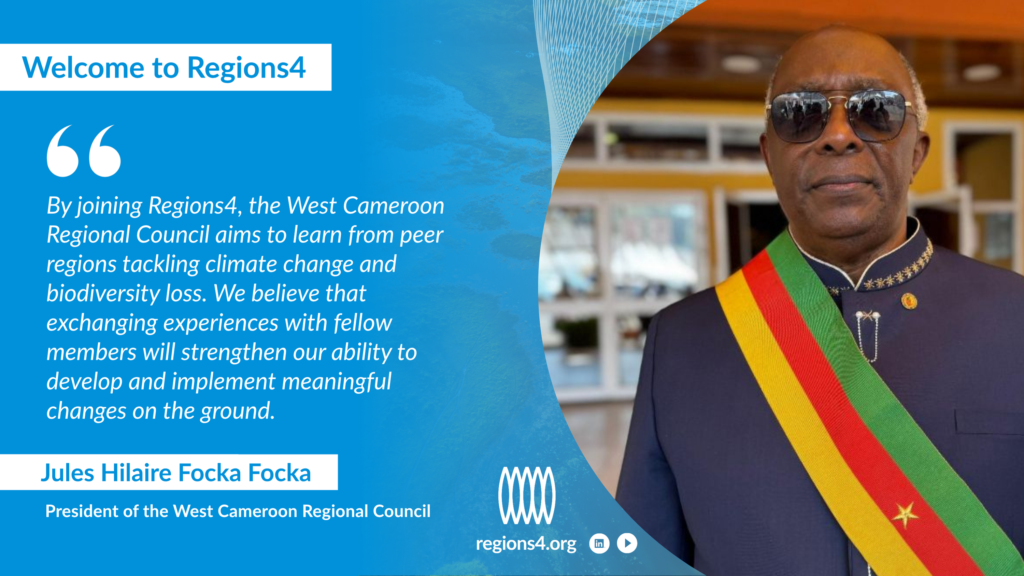
By becoming a member of Regions4, the West Cameroon Regional Council wishes to benefit from the dialogue of experiences in climate change adaptation and biodiversity protection. We are committed to taking action for our planet and believe that exchanges with other Regions4 member regions can help us develop and implement climate plans.
3. What knowledge or sustainability initiatives do you hope to share with other members of Regions4?
The West Cameroon Regional Council has launched the pilot phase of a large-scale project to protect wetlands by planting raffia bamboo, which has been shown to positively impact the climate. Alongside that, the region is involved in a major ecotourism project marked by reforestation of the great mountains, with a pilot phase focused on the Mount Mbapit Massif, scheduled to launch before the end of the first half of 2026. And finally, the Valbox project, implemented in Dschangand, which consists of semi-automatic waste sorting for compost manufacturing, could also be a subject of experience sharing with other territories.
Among our growing initiatives, we are advancing:
• The project for the reforestation of wetland lowlands through the planting of raffia bamboo (a project already launched and supported directly by local communities).
• The mountain reforestation project (pilot phase launch imminent).
• Urban forestry project (green urbanization).
• Automatic waste sorting and compost manufacturing project (project implemented in the municipality of Dschang).
The West Cameroon Regional Council considers that permanent consultation with local communities is the key to the success of all its projects. Whether projects are initiated by communities that benefit from the support of the regional government or carried out by the Regional Council, local communities are always integrated into the processes of project preparation, implementation, monitoring, and evaluation.
West Cameroon Regional Council website: conseilregionalouest.cm