Welcome to Regions4: An Interview with the President of Paris Region, Valérie Pécresse
Entretien en français ici [FR]
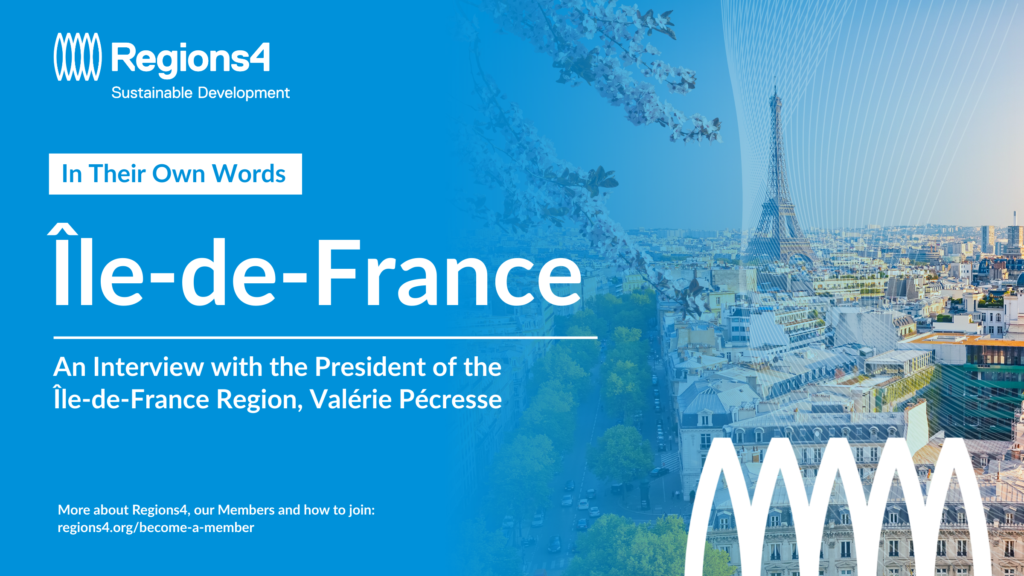
In December 2025, Paris Region, in France, joined Regions4 marking another milestone in its long-standing dedication to innovation and sustainable development. With more than 12 million inhabitants, the region forms a major urban area around Paris, generating nearly 30% of French GDP and making it the most powerful economic hub in Europe. In this edition of In Their Own Words, the president of Paris Region, Valérie Pécresse, reflects on the region’s transition toward a more modern and sustainable future, and on how joining Regions4 will amplify Pari’s Region’s influence and engagement at the European and international levels.
1. What is unique about the Paris Region?
Since Brexit, Paris Region has been the leading metropolitan region in the European Union in terms of its demographic, economic and strategic importance. With more than 12 million inhabitants, Paris Region forms a major urban area around Paris, generating nearly 30% of French GDP and making it the most powerful economic hub in Europe. As a leading political, diplomatic, cultural and scientific centre, we are home to major institutions, global headquarters, centres of research excellence and the largest business district in continental Europe. Thanks to its exceptional connectivity – international airports, the European high-speed rail network, logistics infrastructure – Paris Region plays a central role in European and global trade. Finally, Paris Region includes highly urbanised and affluent areas, such as Paris, but also working-class neighbourhoods and rural areas (75% of the region is made up of farmland, forests and natural spaces). The region’s role is to reduce the divides between these areas and populations so that they can all contribute to the dynamism of an attractive region.
2. What are the main sustainable development initiatives in your region?
As soon as I took office as head of the region, I launched a transport revolution: a more modern and denser public transport network that offers a credible, reliable and clean alternative to private cars. As a result, we are now the only region in France to have significantly reduced road traffic. And this reduction in traffic automatically translates into a significant reduction in emissions. We have also rethought our development strategies by putting clear rules in place: stopping urban sprawl, preserving our agricultural land and renovating rather than building further and further afield. This strategy reduces emissions associated with buildings and travel at source. In total, greenhouse gas emissions fell by 35% in Paris Region between 2010 and 2022, and PM2.5 fine particulate matter by 43%. This is a significant achievement and something we can be proud of.
We have also drawn on what makes our region unique: the presence of numerous naturally warm deep aquifers with exceptional geothermal potential. Paris Region has thus become the world’s leading region in terms of urban geothermal density. Dozens of heating networks provide clean, local energy, which is a sustainable replacement for gas imports. One million residents of the Paris region are connected to these networks. And since 2016, we have supported more than 300 projects to achieve this. In 2022, we launched a major plan to adapt the Paris region to climate change in order to take action that is closely aligned with the local realities of our region. This enables us to protect not only ecosystems and biodiversity, but also the most vulnerable residents of Paris and our economic fabric. Since 2016, the Paris Region has planted nearly 1.5 million trees and acquired nearly 800 hectares of green spaces, adding to the 15,000 hectares managed by Île-de-France Nature, our regional operator responsible for the protection, management and enhancement of natural, agricultural and forest areas. Finally, we are encouraging the transformation of our businesses and supporting the decarbonisation of our industry.
In 2026, we will continue to decarbonise and prepare our region for global warming, and we will continue to reduce our carbon emissions with the ambitious goal of reducing our transport-related emissions by a quarter by 2030. With nearly 60% of investment expenditure favourable or very favourable to climate change mitigation, we are giving ourselves the means to achieve our ambitions.
In every policy area – climate, biodiversity, circular economy – we start from a simple rule: co-construct with local actors so that solutions are adapted and actually implemented on the ground.
3. How does your region engage with local communities and stakeholders in the implementation of sustainable development policies?
In practical terms, we work hand in hand with local authorities. For example, for our circular economy policies, we work with the Paris Region Institute to lead a community that brings together local authorities, associations and businesses to develop operational solutions together. It is this collective effort that has enabled us to launch local projects funded by the Region and Europe, in particular through calls for projects dedicated to supporting changes in practices.
Another example: on biodiversity, we rely on the Regional Biodiversity Agency, which brings together public and private actors to support municipalities in restoring their ecological continuity. Here again, it is the local authorities that define their priorities, whi , and the Region provide the engineering and financing. Paris Region Nature also works directly with municipalities, inter-municipal bodies, farmers and local associations to preserve open spaces, develop renaturation projects, open sites to the public and reconcile biodiversity protection with local uses. It is a highly operational tool for partnership with local authorities, enabling us to translate our environmental objectives into concrete action on the ground.
Finally, on the climate front, we have chosen to rely on science by creating GREC, the Regional Expert Group on Climate Change. This multidisciplinary network of researchers and practitioners, supported by the Region, universities and several local authorities, provides public decision-makers with regional assessments and up-to-date scientific knowledge. GREC plays a key role as an interface between science and public decision-making, helping local authorities to base their climate and environmental strategies on robust data, while promoting dialogue between researchers and actors in the field. In every policy area – climate, biodiversity, circular economy – we start from a simple rule: co-construct with local actors so that solutions are adapted and actually implemented on the ground.
4. What are your expectations in joining Regions4?
In this period of national budget cuts, many French regions have decided to take up the torch of ecological transition. This is certainly the case for Paris Region. We are thus becoming the leading players through our investment policies.
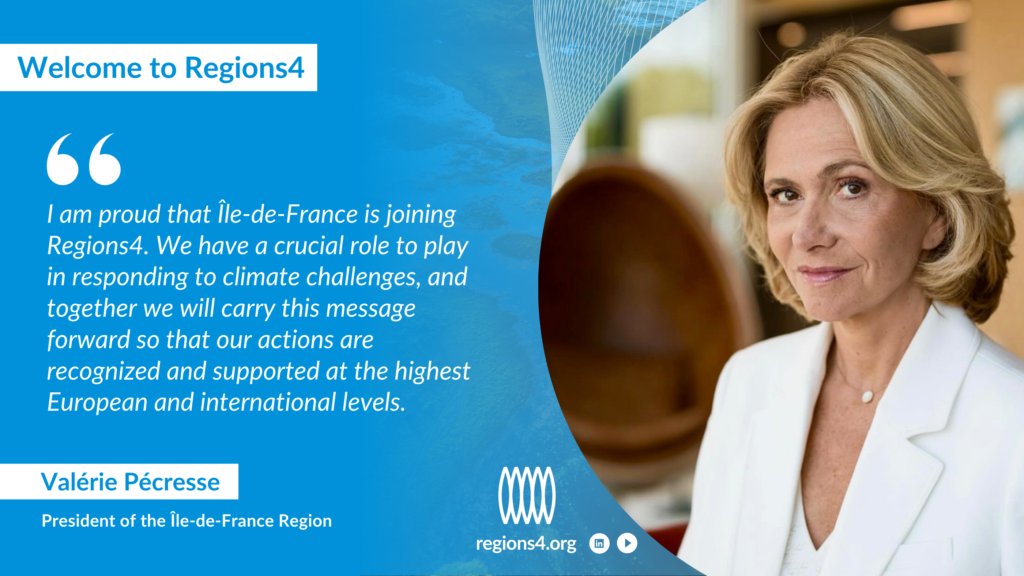
By joining Regions4, Paris Region hopes that the role of regions in sustainable development will be fully recognised and that our actions will be supported and strengthened at European and international level. The financial and institutional resources made available to regions must be increased to enable us to take the necessary action to respond to the climate emergency and halt the collapse of biodiversity. By joining Regions4, we will carry this message together.
5. Are there specific areas of Regions4 where you see immediate opportunities for collaboration?
Yes, very clearly. First and foremost, adaptation to climate change in large urban areas. Cities are home to large populations, critical infrastructure and climate vulnerabilities. Heatwaves, floods, water stress, ageing populations: these are shared challenges. The Paris Region has implemented structural policies for renaturation, de-impermeabilisation, water management and protection against climate risks, and wishes to compare these approaches with those of other regions facing similar hazards. Secondly, decarbonising heating, in particular through heating networks, heat recovery, urban geothermal energy, energy efficiency in buildings and the gradual phasing out of fossil gas.
Finally, interregional cooperation as a lever to overcome international deadlocks. Regions4 is precisely the space where regions can act together where states sometimes struggle to cooperate fully, by building operational coalitions, comparable to those we have already established with Attica, Madrid, Brussels and Lisbon.
My belief is that regions can do what states are not always able to do. This is the whole point of our membership of Regions4, the global coalition of regions committed to climate, biodiversity and sustainable development, of which we are proud to be a part.
6. What knowledge or experience do you hope to share with other members of Regions4?
Paris Region wishes to share proven feedback based on public policies implemented on a large scale in a densely populated and economically attractive region. We are particularly interested in feedback on the circular economy, water management and the fight against urban heat islands. For our part, we can offer solid experience in sustainable mobility, based on investment rather than constraints: massive modernisation of public transport, electrification, incentive pricing, new railway lines, cycling and credible alternatives to private cars. We can also demonstrate our pragmatic approach to land use efficiency, with a voluntary target of zero net land take, in order to reconcile economic development with resource conservation.
Finally, we will be able to demonstrate our management method, based on measurable indicators. In addition, in 2024 the Region adopted a green budget, a simple and transparent tool for measuring the environmental impact of its budgetary choices. This exercise shows that more than half of regional investments – 58% to be precise – contribute directly and positively to the fight against climate change.
7. How do you intend to leverage your membership of Regions4 to increase your region’s visibility and influence on the global stage?
I firmly believe that together we can achieve more. It is by joining forces that we can hope to reach the critical mass needed to influence the broader balance of power. We have therefore signed a joint declaration of intent with several European climate partners: with the Governor of Attica, with the Government of the Brussels-Capital Region, with the President of the Autonomous Community of Madrid, and with the Lisbon Metropolitan Area. The Region of Upper Austria has also committed to this initiative. Lower Austria has also signed up. In concrete terms, we are comparing the implementation of our climate change adaptation plans to identify what works best, and we are coordinating our efforts to find funding from international and European institutions. My belief is that regions can do what states are not always able to do. This is the whole point of our membership of Regions4, the global coalition of regions committed to climate, biodiversity and sustainable development, of which we are proud to be a part.
Paris Region website: www.iledefrance.fr
Paris Region joined Regions4: www.iledefrance.fr/toutes-les-actualites/climat-la-region-ile-de-france-rejoint-le-reseau-regions4