The starting point for a region’s journey to SDG implementation
The starting point for a region’s journey to SDG implementation is ensuring commitment at political level, which can be formalized in several ways, and should set the ground for a governance mechanism. At technical level, it is recommended to form a team dedicated to setting up an SDG framework.
Prerequisites to the process are also an enabling training on sustainable development across the administration and the engagement of territorial actors, with activities to ensure the capacity of all groups to effectively participate in the further steps.
Objective:
To ensure political commitment and prepare the ground for developing a Regional SDG Framework
Output:
Formalized political commitment Regional SDG governance set up
SDG Task Force created
Enabling capacity within the regional government
Territorial engagement mechanism established
Actions
Political commitment provides the leadership, legitimacy, and momentum needed to turn the goals into action.
It enables an actual confrontation with territorial actors on a transformative process that by no means can be intended as merely technical.
The traction of a regional leadership committing to the SDGs, moreover, has an impact well beyond the region’s borders and contributes to a global movement of subnational governments that play a growing role in advancing momentum for the Goals.
How to strengthen the case for an SDG mainstreaming process in the region:
Opportunity to strengthen the relevance and effectiveness of public policy by ensuring an integrated approach between economic, social and environmental dimensions.
Acknowledging the diversity of the population and strengthening social cohesion
Improving collaboration across policy sectors, levels of government and with stakeholders, leading to more coherent and integrated policy making
Equipping regions with capacity to better anticipate and respond to short and long-term challenges related to e.g. climate change, demographic changes, geopolitical instability and inequality, ensuring policies remain sustainable and inclusive over time
Setsharedgoalswithstakeholders
Show a consistent and long-sighted development plan for citizens, stakeholders, investors and others
The governance structure is the engine of SDG implementation: it ensures that each actor has a clear role and responsibility, that decisions are transparent and legitimate, and that adequate resources are invested to carry out each activity.
The SDG governance of a region should be embedded in a broader multilevel framework.
Within the regional government, this encompasses actions to institutionalize the commitments towards sustainable development at the highest political level, make them enforceable through normative measures, policy directions and institutional arrangements, and formalize the coordination, integration and synergies across governance levels, policy domains, and societal actors through official documents.
Creating a strong SDG governance setting:
Set up an internal SDG coordination mechanism, involving representatives of all policy sectors. Both political and technical representatives should be involved.
Establish a formal process for the definition of regional SDG commitments, ensuring equitable participation of all territorial actors.
Formalize the role of SDG commitments in the region’s decision making and policy planning processes. For instance, performance targets can be assigned to directors/managers.
Coordinate with other levels of government to ensure alignment of goals and actions, with clarity on roles and competencies.
For the whole administration to be onboarded and participate in the mainstreaming of the SDGs, it is crucial to disseminate key information and enabling skills across the administration.
Effective actions include:
Integrating training on Agenda 2030 and SDG-oriented policymaking as a part of the overall training provided to public officials.
Delivering sessions on specific practices such as strategic foresight for public policymaking, SDG budgeting etc.
Regularly engaging officials from all departments in the activities related to the SDG strategy (update, stakeholder input integration), monitoring (data collection and analysis, policy evaluation), stakeholder engagement etc.
Regions4 can support defining a training program on sustainable development for regions and involve experts from academia, international organizations, and other regional governments.
Knowledge and skills to convey in SDG training to regional officials
Understanding of the principle of sustainable development, its evolution, potential, and critics
Ability to identify relevant indicators to monitor topics of competence in a sustainable development perspective
Ability to identify interconnections (synergies, trade-offs) with other policy areas
General knowledge of the SDGs, with a focus on targets and indicators of the respective areas of competence
Ability to align respective topics of competence to SDG targets
Ability to identify key territorial actors to involve in policymaking and engage in action implementation
It is recommended that regions establish a task force of experts to guide the setting up of an institutional SDG framework. The SDG Task Force will be responsible to engage with representatives from relevant regional departments, regional councils, district bodies and key non-governmental stakeholders.
To be effective, the Task Force will need a clear work plan and endorsement from the highest political level. It is recommended that it is housed within the office of the head of the region. It can include staff from the government, technical support, and representatives of key stakeholder organizations.
Key characteristics and skills of a regional SDG Task Force:
Strong motivation to bring about a systemic change in the region and innovate governmental practices
Comprehensive knowledge of the cornerstone treaties and agreements defining sustainable development, from Agenda 2030 to local documents
Projectmanagementskills
Deep understanding of the region’s administrative processes
Ability to engage with all policy areas to promote transversal SDG integration
Data analysis skills
Communicationskills
Workplan to implement the Regions4SDGs Framework
Introduction: Provide context to the envisaged work, describing the background to why the initiative is being carried out.
Objectives/ Goals: Describe the purpose and expected outcome of the workplan e.g. ‘to mainstream the SDGs in the region’.
Scope of work: Describe of the initiative, providing information about what is included/excluded from the plan.
Responsibilities: Describe the team involved and add information on the key stakeholders involved.
Tasks and Activities:Provide a breakdown of the initiative, consisting of the tasks to be carried out – and assign tasks to the responsible entity.
Timeline: Add start and expected end date, including deadlines for each task.
Governmental action is crucial, but not sufficient, to achieve a systemic transformation. The commitment, mobilization and participation of all actors of society is needed to support SDG implementation and to shape collective decisions and policies. A comprehensive stakeholder mapping and analysis can be carried out to identify those who should be involved in developing the SDG Framework.
Mapping stakeholders
In line with the ‘whole-of-government’ and ‘whole-of-society’ approach, the mapping and analysis should consider both governmental and non-governmental stakeholders.
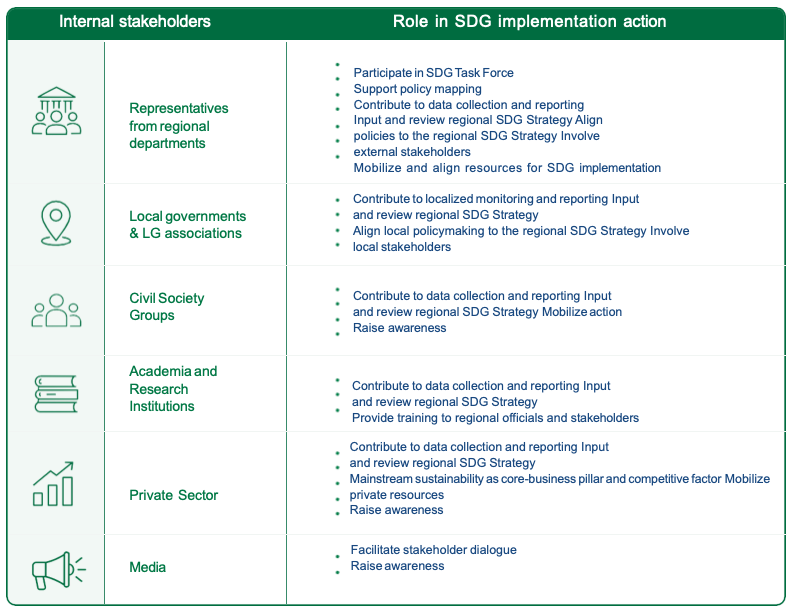
As an initial step, it is helpful to map stakeholders engaged in sustainable development across government, academia, civil society and the private sector. This can include preparing an organigramme of units and focal points in departments.
The mapping can help assess the current level of coordination on sustainability efforts and clarify how stakeholders are connected across sectors.
A guiding table for stakeholder mapping:
Stakeholder analysis
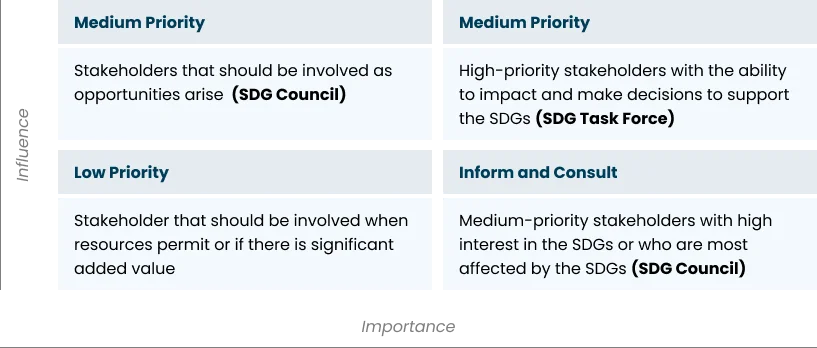
Following the completion of the mapping, a stakeholder analysis should be conducted to assess the influence, interests and relevance of the stakeholders in relation to the SDGs.
The following grid can be used to group the stakeholders according to their influence and their relevance in relation to the SDGs:
The SDG Council serves as a platform to engage all the actors who must be represented in regional decision-making and who can contribute to action implementation and data collection. Engagement mechanisms vary widely depending on factors such as existing channels of representation, organized constituencies, and the objectives pursued.
However, some elements of an effective engagement mechanism can be identified.
Role of an SDG Council:
Facilitate consultations of regional stakeholders on sustainable development challenges, goals, and solutions in the region, enabling participatory policymaking
Support monitoring and reporting on SDG implementation, involve stakeholders in VLRs
Coordinate activities with and between local actors
Raiseawareness
Suggested Members:
Local governments Youth organizations Women’s groups
AcademiaandResearchinstitutes
NGOs working on topics of relevance for sustainable development Foundations and other development promoting organizations
Employer’s organizations and trade unions
Business representatives from various sectors
Public and private utility providers Banks and financial service providers
Recommendations – an effective mechanism should include:
A clear governance and transparent and equitable criteria for participation, with consideration for groups that for structural or historic reasons do not have structured representation (e.g. youth).
Defined objectives and expected outcomesofthemechanism(e.g.defining an SDG Strategy, discussing sectoral policies, producing policy papers, facilitatingterritorialpartnerships).
A structured program of activities – regular meetings, defined agendas and follow-ups, formal outcomes – with a sizeableimpactontheregion’sactivities
Use an existing mechanism or build a new one? – criteria to decide:
Does the council have clear lines of accountability and strong leadership?
Are there formal inclusion and equitable participation of regional actors?
Does the council encompass“ leaving no one behind?” (having representation of marginalized people)
Does the council lend itself to non-partisan agreement?
Is monitoring and review part of the structure?
Recommendations
Ensure political commitment to develop an SDG Framework.
Consider the benefits and challenges of developing a framework for the region.
To ensure a multi-stakeholder and inclusive approach to developing a framework, a mapping and stakeholder analysis should be carried out.
Stakeholders should be analyzed from a policy coherence perspective i.e. how can they contribute to vertical and horizontal integration of the SDGs.
Establish a Task Force and an SDG Council with clearly identified roles and responsibilities laid out in Terms of Reference
Develop a workplan that is endorsed by the highest political level in the region.
Ongoing exchange between regions, including through mentoring and communities of practice, can support continuous improvement and scaling of solutions.
Discover the tools and resources that can support your journey in SDG localization
Stakeholder’s Mapping Tool
The 2030 Agenda’s multistakeholder approach calls for an enabling environment that fosters inclusive participation and encourages innovative partnerships to mobilize and share knowledge, expertise and financial resources across all levels. This practical guide offers guidance for government officials and stakeholders seeking to strengthen participation and inclusion in the implementation and the follow up and review of the 2030 Agenda. It provides guidance on participatory approaches and presents practical tools and methods to support these efforts.
This report introduces a framework designed to capture: the core dimensions of Multilevel Governance processes as shaped by policy coherence and integration, as well as the principles and enabling conditions that transform these processes into concrete practices and the resulting outputs and outcomes, particularly in terms of strengthened capacities and improved mechanisms for localizing the SDGs. At the heart of the framework are the need for vertical and horizontal integration and stakeholder engagement, making it a useful tool to map, organize and analyze regional governance practices for localizing the SDGs.
This website uses cookies to improve your experience. We'll assume you're ok with this, but you can opt-out if you wish.AcceptRejectRead More
Privacy & Cookies Policy
Privacy Overview
This website uses cookies to improve your experience while you navigate through the website. Out of these, the cookies that are categorized as necessary are stored on your browser as they are essential for the working of basic functionalities of the website. We also use third-party cookies that help us analyze and understand how you use this website. These cookies will be stored in your browser only with your consent. You also have the option to opt-out of these cookies. But opting out of some of these cookies may affect your browsing experience.
Necessary cookies are absolutely essential for the website to function properly. This category only includes cookies that ensures basic functionalities and security features of the website. These cookies do not store any personal information.
Any cookies that may not be particularly necessary for the website to function and is used specifically to collect user personal data via analytics, ads, other embedded contents are termed as non-necessary cookies. It is mandatory to procure user consent prior to running these cookies on your website.