Track 2 guides the region in identifying the key priorities and an implementation strategy for a sustainable transition.
The process starts from scenario planning and consultations to define a long-term vision, localized goals and specific activities to achieve them.
Objective:
To develop an evidence-based and Regional SDG Strategy that is based on an inclusive and participatory multi-stakeholder approach
Output
Regional SDG Strategy, including
Sustainable Development Vision
Strategic Goals and Objectives
Action plan
Connection with regional policy planning
Actions for multilevel coordination
Actions to disseminate, raise awareness, and engage citizens
Actions
Scenario planning is a strategic tool to design forward-looking strategies developing narrative-based future scenarios with a multi-stakeholder approach. It involves a structured analysis of how different uncertainties might unfold and affect key issues – urgent and evolving challenges related to megatrends such as climate change, demographic shifts, urbanization, digitalization etc. Each scenario therefore considers likely trends, areas of uncertainty, and potential shocks – both positive and negative.
Using strategic foresight for scenario planning
To help the scenario building process, strategic foresight is recommended. As a first step in the process, the drivers – or pathways – of long-term change should be detected. These are then used to explore possible futures or scenarios that can help guide the region’s policy and investment needs on the SDGs. Participatory approaches – such as convening a workshop – should be used to carry out scenario planning.
Integrating the SDGs in regional policymaking and promoting a systemic change is an inherently political process that affects all parts of society. Therefore, it is crucial to embed participation in each step, to ensure all actors’ voice is listened to in the definition of regional goals and actions. Moreover, participation is essential to create ownership of the transformation, necessary to turn commitments into concrete, systemic action.
Forms of consultation
Various forms of consultations can be considered: workshops, roundtables or policy dialogues, focus groups, surveys or questionnaires, social media chats, radio or online platforms. The core infrastructure enabling consultations is meant to be the SDG Council established during the Onboarding track. This process can be further strengthened through exchange with other regions undertaking similar SDG localization efforts within the Regions4 network.
While Agenda 2030 provides a global framework and a common language on sustainable development, each territory has very specific characteristics, from its morphology and ecosystems to its social and economic setting, that need to be considered to effectively localize the SDGs. To systematically transpose the SDGs to the territory, regions can develop a regional SDG strategy.
Shape a vision
Using the scenarios identified in the scenario planning workshop can help define a long-term regional vision of the future. The vision captures the “big picture” of what the region wants to achieve through SDG mainstreaming.
A vision statement serves to build a shared understanding of the overarching purpose of mainstreaming the SDGs in the region. To foster ownership, the vision statement should be formulated with the help of stakeholders e.g. based on the consultation and/or the involvement of the SDG Council.
Define regional strategic goals and objectives
In partnership with the SDG Council and informed by the outcome of the data track, scenario planning and consultation processes, strategic goals and objectives should be defined. These goals may be broad and cross-cutting and should be aligned with the vision statement. Each strategic goal should be supported by clearly defined objectives and expected outcome necessary for its achievement. Using the policy mapping carried out in the Data Track, it is also recommended to connect objectives with relevant policies. Blank cells will highlight policy gaps.
Strategic Goal: Empower enterprises to turn sustainability in a driver of value creation and business development
Objectives
Expected Outcome
Corresponding SDG /Target
1.1 Increase sustainability competencies in the private sector
1.1 X% of businesses in the region have at least one employee with certified training on sustainability
Target 6: Encourage companies, especially large and transnational companies, to adopt sustainable practices and to integrate sustainability information into their reporting cycle.”
1.2 Increase the share of enterprises that embed sustainability in their business model
1.2 X% of businesses in the region have undergone a sustainability process
1.3 Increase the availability and skillset of local sustainability professionals
1.3 X sustainability professionals are active in the region
Strategic synergies
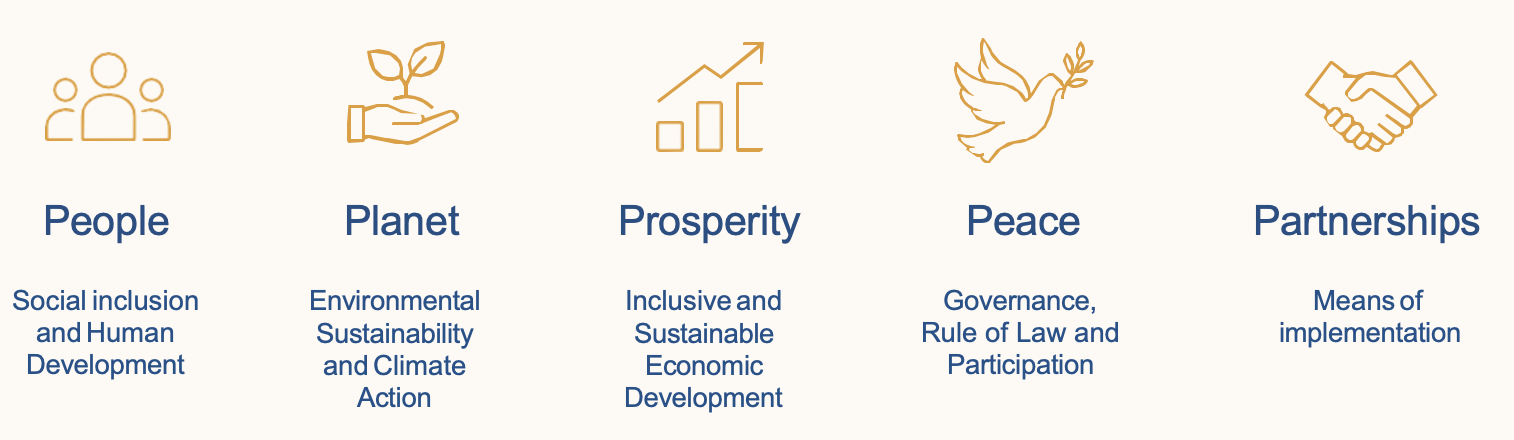
In the strategy, consideration for the synergies between the SDGs should be given. This can be achieved by structuring the strategy around key clusters e.g. people, planet, prosperity, peace and partnerships:
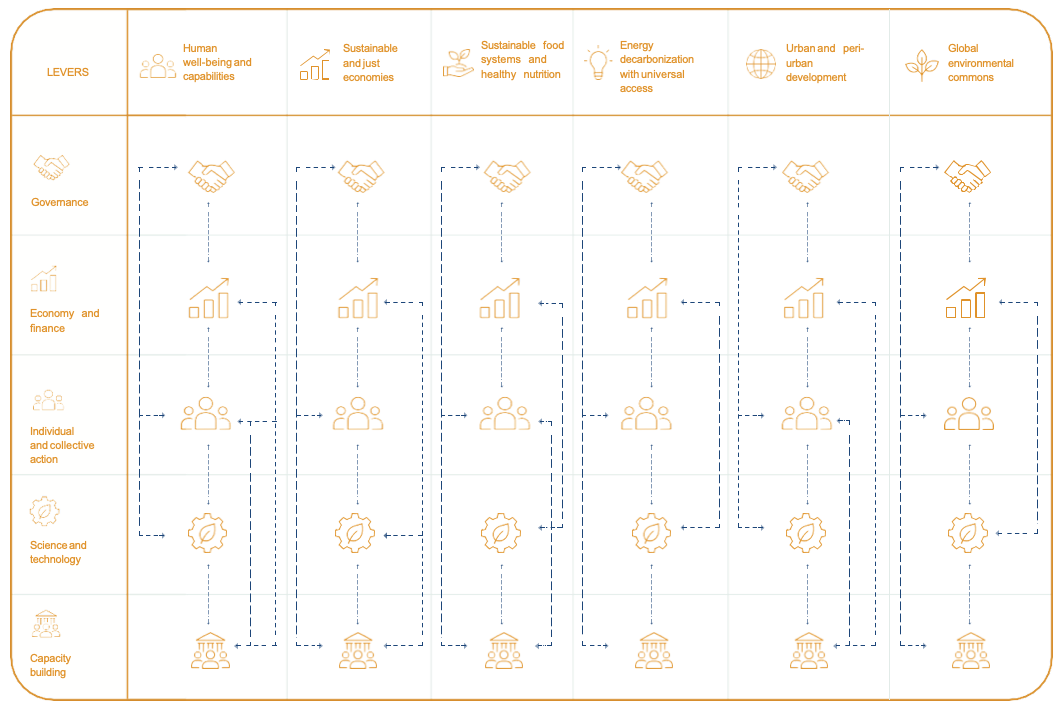
Another option is using the entry points and levers identified by the Global Sustainable Development Report 2023:
ENTRY POINTS FOR TRANSFORMATIONUnited Nations. 2023. Global Sustainable Development Report 2023 Times of Crisis, Times of Change, New York
Identify key policy instruments and implementation actions
To achieve the chosen goals, regions need to identify the main policy instruments through which implementation actions can be planned, and the key actions they plan to carry out.
The implementation section of the SDG Strategy should include assigned responsibilities, the actors leading and supporting each action, and the most relevant and impacted stakeholders. The stakeholder mapping conducted during Onboarding and the policy mapping carried out in the Data Track should provide a strong enabling background for this process.
Estimate costs
Estimating the cost of each action is required to identify resources from the regional budget and to create an investment pipeline for external financing, as explained in more detail in Track 3.
Monitor and review
The monitoring system and review processes described in Track 1 on Data provide key tools to establish a regular monitoring mechanism, providing transparency and allowing the region to keep updating goals and actions of the SDG Strategy.
Key elements for an effective SDG Strategy
A Regional SDG strategy should be intended as a process rather than as a still document. Its value depends on its impact on regional policymaking, on citizen and stakeholder engagement, and on its capacity to integrate individual projects and policies in a systemic vision – thus increasing public acceptance and trust by stakeholders, including financial actors. A key element to achieve such effects is co-creating the Regional SDG strategy with citizens and stakeholder groups, with a strong participatory approach. In addition, specific mechanisms can increase the alignment of policies to the SDGs and their consistency with each other, such as strategic sustainability evaluations and green budgeting practices. Finally, the impact of SDG Strategies is highly dependent of the effectiveness of the governance model adopted by the region.
Benefits of an SDG Strategy An SDG Strategy can provide the region with a:
Proof of political commitment towards Agenda 2030
Analysis the region’s characteristics and SDG positioning in relation to global trends and future scenarios
Long-term plan, spanning across the political programs of single mandates
Map of the areas of competence of the regional government against the SDG targets
Vision for territorial development, politically backed and legitimated by the collaboration of stakeholders
Platform for policy coherence and cross-sector coordination
Recognition of territorial actors and their contribution to the region’s sustainable development
Specific mechanisms can be adopted to ensure the coherence of all regional policies, actions, and investments with the SDG Strategy.
Strategic sustainability assessment
An evolution of the strategic environmental assessment already adopted by many regions, a sustainability assessment has a broader scope and uses the Regional SDG Strategy as a reference to check that a proposed plan, policy, initiative, or investment is consistent with the regional goals and does not impair other regional activities that benefit specific objectives.
SDG budgeting
SDG budgeting involves aligning the government’s public financial management (PMF) systems – such as planning, budgeting, expenditure, and reporting – with the SDGs.
This helps to make sure that public funds are effectively directed toward achieving sustainable development.
Several methodologies are available to map the contribution of a regional budget to the SDGs and to assess the positive, neutral or negative impact of each budget item on SDG implementation.
Public efforts for SDG implementation are more effective if data, agendas and consultation/engagement processes are well coordinated across levels of government. Supporting municipalities and intermediate institutions (provinces, counties etc.) is a strategic investment to enhance regional action.
Foster multilevel coordination:
Engage local political leaders as drivers of local SDG implementation processes
Provide guidelines and technical support to develop local SDG agendas and to guide their integration in local policymakin
Scale down the regional SDG monitoring system to monitor local data
Support local stakeholder engagement processes
Facilitate practice exchange among local institutions
Listen to local institutions and integrate their perspective in regional SDG action
Compelling narratives and decisive campaigns are essential to engage all actors of society by translating the SDGs in the respective contexts and communicative codes. They allow regions to inform citizens, share ownership of the transition process, foster participation and mobilize territorial action. Cultural action for the SDGs, however, should not be one-directional; rather, it should foster a multi-voiced dialogue that brings forward the perspectives, visions, and needs of all segments of society. Regions play a particularly important role in this regard, as they are well positioned to connect diverse communities and stakeholders within a clearly defined territorial context.
Key actions to raise awareness
01. Having identified the key actors of the transition in the region during Onboarding – their roles, needs, languages – shape targeted campaigns and messages to onboard each category of actors in the transition (e.g. civil society associations, enterprises, trade unions, universities, etc.).
02. Create space for dialogue and amplify the voice of society groups, with special attention to underrepresented ones. The SDG Council can provide a platform for this, but additional initiatives might be required to reach a broader audience.
Recommendations
Develop a Regional SDG Strategy based on long-term planning efforts
Ensure long-term planning factors in risks and crises by applying foresight and scenario planning
Ensure ownership of the SDG planning by organizing a consultation with a broad group of stakeholders and/or among the population
Develop a ‘Sustainable Development Vision’ that outlines the long-term ambitions of the region. Base the vision on the outcomes of the scenario planning workshop and consultations.
Communicate the Vision to the public
Identify strategic goals and objectives connected with monitoring indicators, policies and budget items
Identify key actions that help to support the strategic goals and objectives of the strategy
Consider organizing the Regional SDG Strategy around the GSDR entry points and levers
Communicate the Regional SDG Strategy to the public
Discover the tools and resources that can support your journey in SDG localization
The Global Sustainable Development Report 2023
The Global Sustainable Development Report (GSDR) 2023 identifies critical sectoral transformations required to advance the SDGs. It highlights key insights and actionable tools, introducing a conceptual model that breaks down the transformation process overtime. It presents a model for understanding the transformation process over time and outlines the roles of different levers facilitating various stages of the transformations. The model can be applied as an organizational structure for national and regional SDG strategies, VNRs and VLRs.
The manual introduces strategic foresight as a critical practice for anticipating and preparing for future uncertainties and opportunities. It emphasizes the importance of foresight in enabling public institutions to make informed, long-term decisions that align with the SDGs. The manual outlines various techniques, including scenario planning and offers concrete suggestions on how to incorporate foresight into different stages of policy planning highlighting participatory approaches to ensure diverse perspectives inform long-term future planning.
This guide is a comprehensive resource designed to support individuals or teams at any stage of their foresight journey. It serves as a practical entry point into the world of foresight, helping users frame, design, and lead effective foresight initiatives.
This website uses cookies to improve your experience. We'll assume you're ok with this, but you can opt-out if you wish.AcceptRejectRead More
Privacy & Cookies Policy
Privacy Overview
This website uses cookies to improve your experience while you navigate through the website. Out of these, the cookies that are categorized as necessary are stored on your browser as they are essential for the working of basic functionalities of the website. We also use third-party cookies that help us analyze and understand how you use this website. These cookies will be stored in your browser only with your consent. You also have the option to opt-out of these cookies. But opting out of some of these cookies may affect your browsing experience.
Necessary cookies are absolutely essential for the website to function properly. This category only includes cookies that ensures basic functionalities and security features of the website. These cookies do not store any personal information.
Any cookies that may not be particularly necessary for the website to function and is used specifically to collect user personal data via analytics, ads, other embedded contents are termed as non-necessary cookies. It is mandatory to procure user consent prior to running these cookies on your website.